People accept a die roll and question a text output. Both are random. The difference is not statistical — it is that one was watched happening.
That is a genuinely useful thing to understand, because it tells you that the objection to a digital draw is usually about visibility, not about trust in the mechanism. Which means it is fixable.
The Visibility Effect
When you watch a die tumble or a wheel spin, you witness the process. There is no interval between the decision and the result where something could have happened, because you were watching the whole interval.
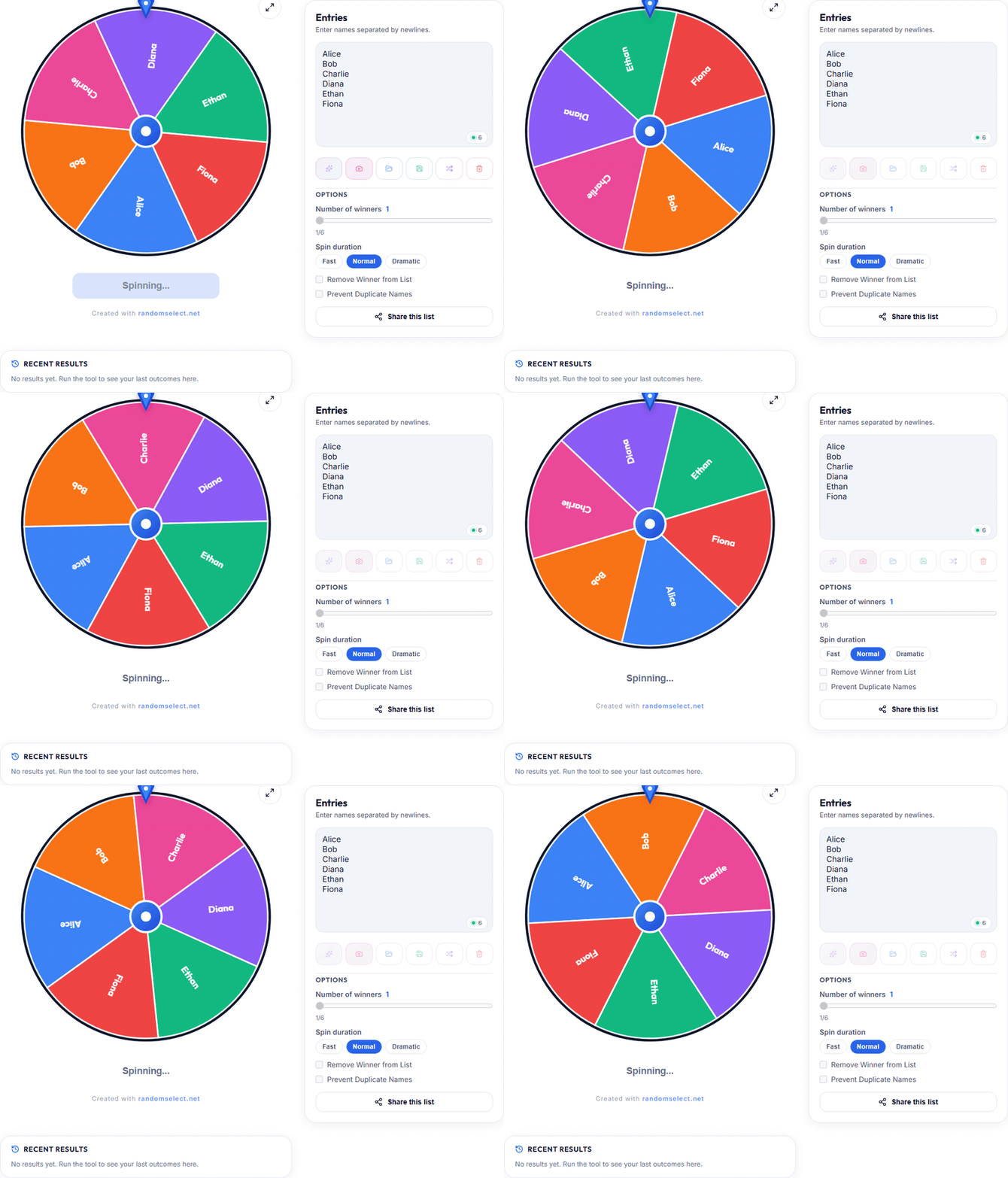
A text output collapses that interval. The result appears and you have no way to know what happened in between — which reads as space for something to happen, even when there is not.
This is not irrational. Under uncertainty, an unobservable process is genuinely less verifiable, and people are correctly responding to that. The mistake is concluding that the unverifiable process is therefore unfair.
The Reason We Watch
The deeper reason visible randomness works is about agency, not computation.
A watched outcome is one you were present for. You cannot later claim it was rigged by someone else, because you saw the whole thing. That removes a category of doubt entirely — and the doubt is usually about other people, not about physics.
This is why handing the device to a student or a team member is the strongest version of any of these practices. They watched from the start. Whatever they think of you, they are not relying on your account of what happened.
Three Ways Human Intuition About Randomness Is Wrong
Gambler’s fallacy. After five heads in a row, tails feels due. Each flip is independent; the coin has no memory of being unfair. The correct answer after five heads is still 50/50, and this is the single most reliably wrong intuition people have.
Clustering illusion. Streaks in random data feel patterned because you are looking for them. In a random sequence, three identical results in a row happens far more often than intuition suggests — roughly once in fifty, not once in a hundred. Long runs are normal.
Expectation that random feels random. This is the deep one. Truly random data looks lumpy and unbalanced over short runs. A sequence that looks perfectly even is more likely to be fake than genuine, because a real random process rarely produces that much order.
The practical consequence: one observation proves nothing, in either direction. A draw that went oddly is as uninformative as one that went smoothly.
Why We Prefer Choosing Anyway
Even when a random draw is clearly fairer, people often prefer to choose. This is not stupidity; it is that a choice feels like yours, and a draw feels like something done to you.
The “control paradox” shows up constantly in classrooms: students prefer raising a hand to being picked, because volunteering is a decision and being picked is an exposure. Both are equally random. The difference is entirely in how it is experienced.
The same thing appears in workplaces, where a manager choosing a presenter is accepted less well than a draw — even though the manager would have chosen fairly.
This is why the framing matters more than the mechanism. “I’m picking you” and “we are drawing this” produce different reactions to an identical distribution.
Physical Tools Are Actually Worse
The trust runs in the opposite direction to the merit.
A physical die can be weighted by manufacturing, by wear, or by rounded corners. Over thousands of rolls on a worn die the bias is small but real — which is why loaded dice are a documented collector’s category.
More significantly, the method is a channel for influence. A real coin can be caught, rotated, or re-flipped, and it lands where the thrower intended. A real die can be dropped, chosen, or handed to a specific player. None of this is about balance; it is about the fact that a person is in the loop.
Digital randomness removes the person from the loop. The result is determined before the animation starts, and nobody can influence it by tapping at the right moment.
| Physical | Digital | |
|---|---|---|
| Worn or loaded over time | Yes | No |
| Outcome chosen before the throw | Possible | Yes |
| Influenceable by timing or catching | Yes | No |
| Uniform across a range (e.g. 40 names) | Depends | Rejection sampling |
| Observable by a witness | Yes | Yes, if recorded |
How to Make a Digital Draw Accepted
The objection is about visibility, so address visibility.
Show the list, not just the result. A witness who saw the participant list on screen knows the pool. A witness shown only a name knows nothing.
Record it. Screen recording with the list in frame converts an assertion into evidence. This is the single highest-value practice for any draw that will be questioned.
Let someone else run it. The affected party operating the tool removes the “they might have rigged it” category almost entirely.
Explain the mechanism in one sentence. Not the maths — the principle. “It uses your browser’s cryptographic random generator, not a predictable formula” is enough for most audiences. The fairness page has the detail if anyone asks.
State the randomness out loud. “Everyone has exactly the same chance” costs three seconds and removes most pre-emptive anxiety.
The Useful Conclusion
People are not irrational about digital draws. They are responding correctly to the fact that they cannot see the process.
So show them. Record the screen, publish the list, hand them the device, explain the mechanism once. What you get is not just a defensible result — you get the part where nobody has to spend the next week managing a suspicion.
And when someone says a result looked suspicious, that feeling is worth taking seriously as communication, even when it is wrong as statistics. Re-running the draw does not resolve it. Showing the recording does.