Most “best random selector tools 2026” pages are ranking lists written by whoever ranks highest, using star ratings and pricing figures nobody verified.
This one is a set of questions instead, because the questions transfer and the rankings do not. Competitor tools change their pricing, their limits and their interfaces without notice; what separates a trustworthy picker from a bad one does not.
The Questions That Actually Matter
What generates the number? This is the question that decides everything else, and almost no comparison page asks it.
Some tools use a formula-based generator such as Math.random(). It is deterministic: if you know the algorithm and can observe enough outputs, you can work out its internal state and anticipate what comes next. For a lunch choice this is irrelevant. For a prize draw, it is the whole question.
Others use the browser’s cryptographic generator — seeded from hardware entropy, and designed so that observing outputs does not reveal the internal state.
A specific, checkable answer (“crypto.getRandomValues()”) is a good sign. “Advanced algorithms” or “AI-powered randomness” is not an answer at all.
How is uniformity achieved across your list size? Picking 1 of 6 is easy. Picking 1 of 40 is where naive implementations go wrong.
Scaling a random float from 0 to 1 onto 40 buckets biases the low end. Some values land past the end of the last bucket, and if they are clamped rather than discarded, the first name comes up slightly more often than the last. The correct approach is rejection sampling — draw, discard anything past the end, redraw.
This matters more than it sounds, because a 1-in-40 bias is invisible in any test you would actually run on a web tool. Ask how it is done, or accept that nobody knows.
Can you see the participant list during the draw? Not the count — the list. A tool showing the pool on screen produces evidence; one showing only the winner produces an assertion.
Can you record the result? Screenshots and screen recording are how disputes get resolved. A tool that blocks right-click or hides the list has removed your ability to defend its output.
What does it require? Account or no account, daily limits, ads, whether lists persist, whether it works on a phone. All legitimate criteria — the trade-offs just differ enormously depending on whether the draw is a classroom exercise or a promotional contest.
Is the mechanism documented? A page explaining the randomness is worth more than a page asserting it. If there is nothing to read, there is nothing to verify.
The Four Kinds of Tool
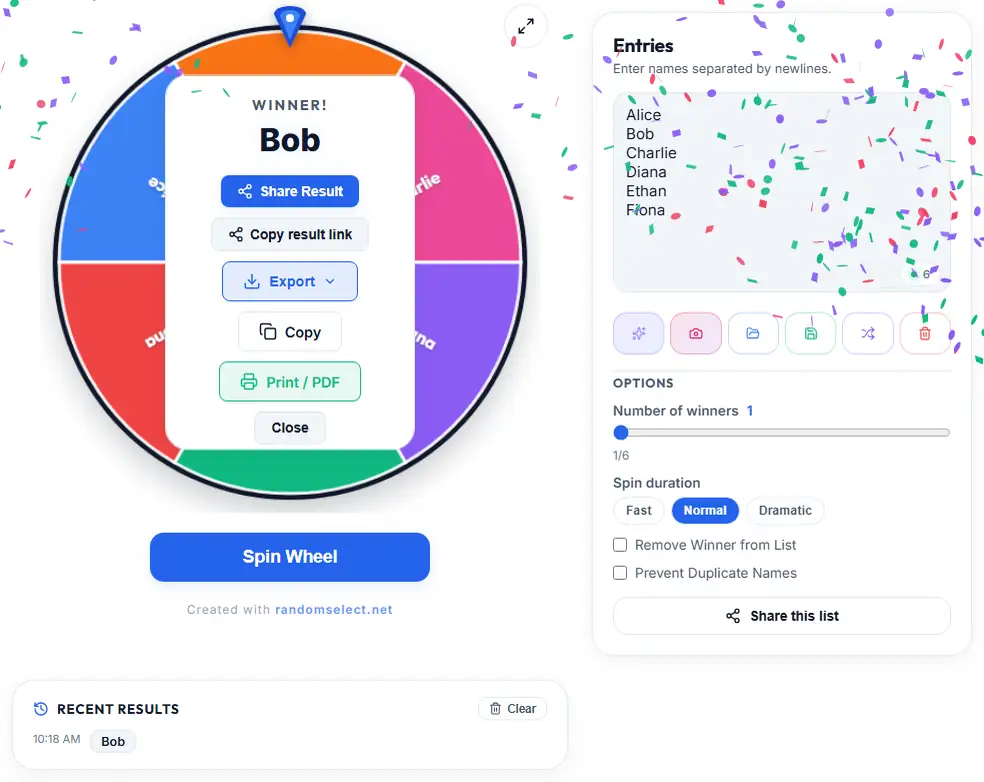
Visual wheels. Names on a spinning wheel. Best where the moment should be visible and dramatic — classroom cold-calling, a stage draw, anything a room is watching.
Flat pickers. A list, one winner, minimal ceremony. Best for repeated routine draws where speed matters — a register check, a homework reminder.
Group makers. Roster to teams. Judge these on the balance logic, not the draw. Does it handle an uneven split without producing a group of one?
Weighted raffles. Entries carry weights. Necessary where extra tickets are legitimate, and where the weighting must be visible because it is what people will question.
Picking the wrong kind is more common than picking a poor tool of the right kind.
What to Distrust in a Comparison Page
Star ratings. A 4.8/5 with no methodology, no number of ratings, and no reviewer identity is decoration. It tells you nothing you can check.
Pricing figures for other people’s tools. These go stale within months. Verify anything you are about to rely on.
“Cons: None significant.” A tool with no weaknesses is not a tool, it is an advertisement. Anything genuinely useful has a limitation worth naming.
“No chance of manipulation.” Every selection can be manipulated — usually not by tampering with the algorithm but by editing the pool, re-running an unpopular result, or applying an unpublished rule. A tool claiming otherwise has not thought about it.
“Truly random” or “100% random.” Vague by construction. A deterministic-but-unpredictable generator is the honest description of what a web tool can offer, and it is the right one.
“AI-powered” as a fairness claim. AI has nothing to do with how a draw is generated. If a tool uses AI for the draw rather than for building a list, that is a serious concern.
What This Site Provides
Since you are here. The tools:
Wheel of Names — visual wheel, for moments that deserve one. Lucky Draw — flat list, one winner, fast. Group Maker — rosters to teams, with pot balance for even sizes and optional random leaders. Task Matcher — people paired with tasks, reporting anything unassigned rather than dropping it silently. Weighted Raffle — explicit, adjustable weights. Dice Roller — d4 to d20, custom faces from 2 to 100 sides, up to 12 dice at once, modifiers from −99 to +99. Coin Flip — custom labels, Best of N, running toss count. Tournament Bracket — elimination rounds including byes. Scoreboard — points tracking with first-to-N and re-ordering. Secret Santa — derangement pairing with your exclusions respected.
On the questions above:
Random source. crypto.getRandomValues(), the browser’s cryptographically secure generator, rather than Math.random(). Group formation uses a Fisher-Yates shuffle, which produces an unbiased permutation without modifying the original list.
Uniformity. Rejection sampling for arbitrary list sizes, so a 40-name draw gives every name exactly 1/40. The short-ID generator applies the same technique with an acceptance rate of 252/256 and a resulting bias of about two parts in ten million.
Visibility. The full participant list is on screen during the draw. It is never hidden.
Recordability. Screenshots and screen recording work normally — nothing is blocked.
Requirements. No account needed to use any tool. No daily limit on draws. Lists can be exported as CSV or XLSX, printed, or copied as text. Twelve languages.
Documentation. The fairness page explains the mechanism, including the rejection-sampling step and why Math.random() is unsuitable.
There are ads on the free version. We would rather state that than claim otherwise, and none of them sit on top of the draw controls.
Real Limitations
Stating these plainly is more useful than a fabricated cons list.
Result determined before the animation. On the wheel and the coin, the outcome is fixed before the spin starts. This is deliberate — it removes any possibility of influencing the result by timing — but it does mean the animation is theatre rather than process. Anyone watching should understand that the mechanism, not the visual, is the guarantee.
No application. Browser only. There is no mobile app, and there is no plan for one.
AI generation sends the prompt to a language model. Useful for building lists, not appropriate for anything containing personal data, since the prompt goes to a third party.
A recorded draw is only evidence if the pool was in frame. This is a limitation of every tool including this one. Start the recording before the draw, not after.
Photographic list import is OCR. It occasionally misreads a name. Read the result before you draw.
Choosing
Classroom, register, homework check → a flat picker. Speed matters more than drama.
Something a room is watching → a wheel. The visual is doing work you would otherwise do with explanation.
Teams or groups → a group maker, judged on balance logic. Check the uneven-split case specifically.
A giveaway with real entries → whatever you can record. Establish that recording works before you run it, because discovering it does not afterwards is a bad evening.
A contest with legitimate multiple entries → a weighted raffle, with the weights published in advance.
The One Property That Decides It
Which tool is fastest, which looks best, and which appears first in a search result are weak signals. The property that actually matters is whether you can show someone why the result was the result.
That means the pool was visible, the method matched the published rules, and the source could not have been anticipated. A tool that satisfies all three will not be the highest rated on a comparison page, and it is the one you want when someone asks afterwards.