The participation problem has a specific cause, and it is not disengagement. Volunteering to answer has a cost — being wrong in front of twenty-nine people — and only some students can afford that cost. The rest are not opting out of learning; they are managing a risk budget.
Random draws change what students are optimising for. Below are ten activities that use that, with the thing each one actually fixes noted, because they are not interchangeable.
1. Mystery Question of the Day
Draw one student at the start of each lesson for the day’s opening question.
What it fixes: attention at the beginning, which is where a lesson is most often lost. The knowledge that any student could be selected is itself worth more than the question being asked.
2. Group Formation
Group Maker replaces ten minutes of negotiation with fifteen seconds.
What it fixes: the “can I work with Sam” exchange, and the quiet fact that hand-picked groups encode your own preferences from years of knowing these students.
The catch: seat the two or three strongest students before you draw. A random split is not a balanced one.
3. Reading Rotation
Draw who reads aloud each day.
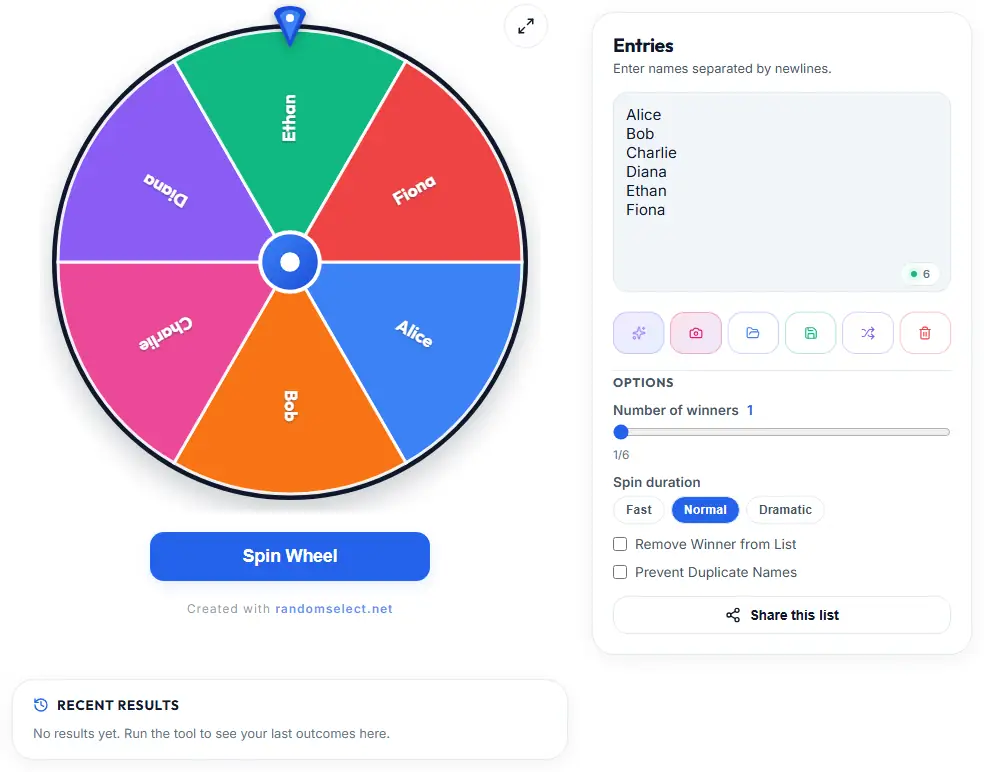
What it fixes: the reading rotation that has quietly assigned the same confident readers every term. Struggling readers get regular practice without being singled out — which is the actual benefit, and it only appears after a few weeks.
4. Quick Knowledge Checks
Draw which student answers which question during a recap.
What it fixes: the same four volunteers answering everything, and the rest treating questions as a performance for others rather than something they need to follow.
5. Reward Draws
Enter students into a weekly draw for a small privilege.
What it fixes: nothing about participation — this is motivation, not assessment, and worth being clear about that. It works when the reward is genuinely valued and it stops working the moment it is routine.
6. Spelling Bee
Draw who spells next rather than taking volunteers.
What it fixes: the students who can spell and do not want to be put at risk. The draw makes the sequence neutral, so preparation becomes the strategy rather than confidence.
The catch: with a large class, this takes too long for a whole lesson. Draw for a subset, or use the elimination structure the game already provides.
7. Partner Pairing
Group Maker with people-per-group at two, for lab partners or paired reading.
What it fixes: the friend-or-nobody negotiation. Also, usefully, it produces pairs nobody expected, and those are the ones that turn into friendships.
The catch: a fixed pair for a term is a fixed pair for a term. Short cycles work better.
8. Discussion Starter
Draw who opens the discussion with their initial view.
What it fixes: the four seconds of silence after a question, and the same student filling it every time. It also changes the shape of the discussion — the opener gets interrupted less.
9. Cleanup Duty
Task Matcher pairs names with jobs.
What it fixes: the small, genuinely irritating grievance that a particular student always gets the same job. Small conflicts that recur weekly consume more goodwill than they are worth.
10. Example Selection
Draw which student examples get used, including the answer that needs work.
What it fixes: nothing about participation, but it produces better discussion. Three good examples are less useful than two good ones and one imperfect one, and drawing avoids the awkwardness of nominating someone.
The Setup That Decides Whether They Work
Build the list before the lesson. Thirty names typed live wastes the moment and gives students time to object to the list.
Full names for duplicates. Two students called Alex means the draw cannot tell them apart, and a near-miss looks like rigged even when it is not.
Save it. Saved lists keeps up to five, works in the browser without an account, and syncs across devices if you sign in. One list per class per term is the unit that makes this sustainable.
Remove absentees first. Otherwise a name comes up, you skip it, and the pool was not the pool.
Say the mechanism out loud. One sentence — “everyone has exactly the same chance” — removes most of the pre-emptive anxiety, and it takes three seconds.
Let students run it. The strongest version of all: hand the device over for the draw. They watch from the start, they can see the list was not edited mid-lesson, and they stop needing to trust that you rigged it.
What Random Selection Does Not Do
It does not equalise outcomes. A class of thirty will not have every student picked equally often over a term. Uniform is not balanced; over a long enough run the gaps close, but they are visible in the meantime. If balance is the requirement, use a rotation.
It does not supply skill. Random selection for a task needing a particular aptitude will sometimes pick the wrong student. Assign those deliberately and randomise everything else.
It does not fix unequal work. Random rotation of a five-minute job next to a two-hour one produces a mathematically fair and practically unfair week. Make the tasks comparable first.
It does not work convincingly on small pools. Drawing one of three names is visibly close to a decision. With small groups, use a rotation instead.
A Note on Framing
Random selection works best as a way of distributing attention across a lesson. It works badly as a device for putting individuals on the spot, and the difference is visible in how students receive it.
If a student who cannot answer looks relieved rather than ashamed, the ratio is right. If they look punished, it has tipped.
The fairness page covers how the draw works, which is worth having ready for the student who asks how you know it is actually random.
Start With One
Use one of these for a fortnight rather than all ten. The register check and the reading rotation are the easiest to sustain; the group formation saves the most time.
The objection, when it comes, will rarely be about randomness. It will be a student who wanted to be picked and was not — which is a different problem, and a better conversation to have.