A giveaway is easy to run and easy to argue with afterwards. The prize is cheap, the reach is the point, and nobody involved is going to accept “trust me” as an answer about who won.
The difference between a giveaway that builds trust and one that generates a comment thread is almost entirely in decisions made before the draw.
Publish the Rules Before the Post Goes Up
Write the entry conditions into the caption and leave them there. Decide and state:
- Follow requirement, and whether a later unfollow disqualifies
- Entries per person — one comment, or unlimited, or one per tag
- What counts as a qualifying tag, and whether extra tags mean extra entries
- Closing date and timezone
- Prize, and how the winner will be contacted
The one that matters most: if unlimited entries are allowed, say so plainly. “Tag three friends for three entries” without stating whether the same person may repeat the comment is the most common ambiguity in giveaways, and it is the one people notice.
Publishing the rules converts every later disagreement into a question of fact rather than a question of judgement. It costs one caption.
Build the List From Real Entries
Instagram and similar platforms will not hand you a clean participant list, so the realistic methods are:
- Read the comments and copy usernames into the tool
- Use your own comment picker and export the data
- Ask for entries by DM — slower, but produces a one-entry-per-person list you can defend
Then clean it. Duplicate usernames under slightly different spellings are the most common data problem and the most embarrassing one, because they are visible in a screenshot. This is also the point at which you remove entries that fail your published rules — before the draw, not during it.
Participant list building covers the mechanics of getting names into the tool efficiently.
Handle Duplicates Deliberately
Prevent Duplicate Names collapses repeated entries to one. Use it when your rules say one entry per person.
Turn it off when your rules intentionally allow weighted entries — multiple tickets, a purchase-based multiplier, unlimited entries — and use the Weighted Raffle instead, which makes the weighting explicit and adjustable. That way the result can be explained honestly: these are the weights I published, here is the draw.
Deciding which of the two applies before you draw, rather than after a dispute, is the whole point.
Drawing More Than One Winner
For multiple prizes, Remove Winner from List lets you draw repeatedly without the same name coming up twice. It also does something less obvious and more useful: the second and third draws run against a smaller pool, so the animation is visibly fair each time rather than only on the first draw.
Check how many prizes you have before you start. Discovering a fourth winner is needed after the announcement is an avoidable problem.
Make the Draw Verifiable
This is where most small giveaways lose trust they did not know they had.
Record the screen with the participant list visible in the same frame. The list is the evidence that everyone who entered was in the pool; a recording showing only the winner announcement proves nothing about it.
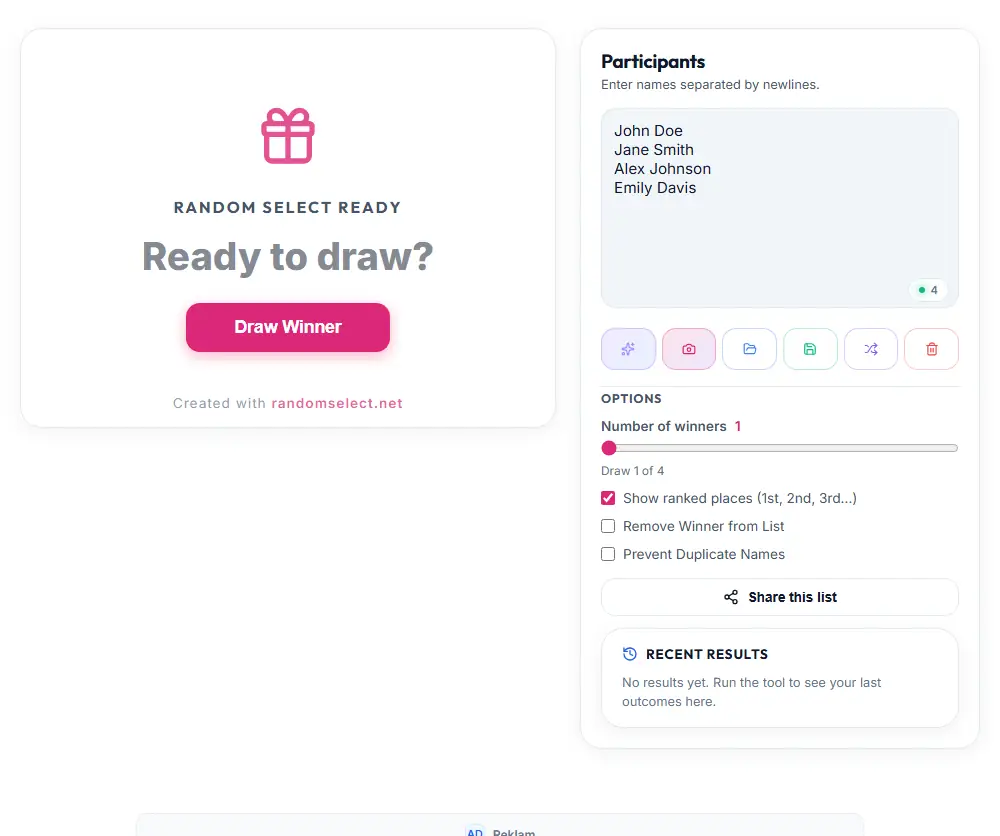
Then publish the result with:
- The winning username
- The number of qualifying entries
- The recording showing list and result together
- A statement that the draw used the published list
That is a complete answer to any objection. If someone still disputes it, you can point at the recording and move on — which is what you want, rather than a week of replies.
Prepare for the Winner Not Responding
Decide in advance how you contact them and what happens if they do not reply. A 48-hour deadline, stated publicly, plus a stated re-draw policy, is the standard arrangement.
Also decide what to do if the winner has deleted their comment or unfollowed. Both happen. Many giveaways re-draw; some disqualify. Either is defensible provided you said which in advance — applying an unpublished rule is the option that reliably produces a public argument.
Apply the Rules You Published
The most common reason a giveaway ends badly is not randomness. It is quietly enforcing a rule that was never stated.
Someone edited their comment six times and your rules said one entry per person. You have a choice: honour the entry, or disqualify on a rule you did publish. What you should not do is disqualify on a rule you invented — that one reliably becomes a thread.
Publish first, apply second.
What People Respond To
A visible draw does something a silent one does not: it gives the audience a moment. The shuffling is a few seconds of engagement, and — this is the part usually left unstated — the blur of names makes the size of the pool legible. People see that three hundred names went in, which is worth more to them than a sentence asserting it did.
That effect is real, and it is also the reason to make sure the recording shows the list properly. The visual proof is the asset. Post it once and reference it, rather than describing the draw in words and hoping it is believed.
A Note on Generated Lists
The AI list generator in the toolbar is useful for testing your flow — timing the announcement, drafting the caption, checking the recording setup. It is not a way to populate the real participant list. Generated names are not entrants, and a draw from them produces a result you cannot publish.
Before You Draw
- Rules published in the caption, unchanged since posting
- Entry closed, full comment list compiled
- Duplicates resolved, rule-based disqualifications applied
- Duplicate protection set to match your rules
- Recording started with the participant list in frame
- Winner-contact process and deadline decided
Six steps. The draw itself takes two seconds.
Ready? Open Lucky Draw, paste your entry list, and start the recording before you press the button.