The reason the same four students answer every question is not that the others are disengaged. It is that volunteering has a cost and only some students can afford it.
Removing the pick from the teacher’s hands and the volunteers from the equation changes what students are optimising for. That is the whole mechanism, and everything else about classroom name picking follows from it.
What It Fixes
Recitation becomes lower-stakes. The barrier is not the difficulty of the question, it is the fear of being picked badly. Take the picking out and more students engage with the material.
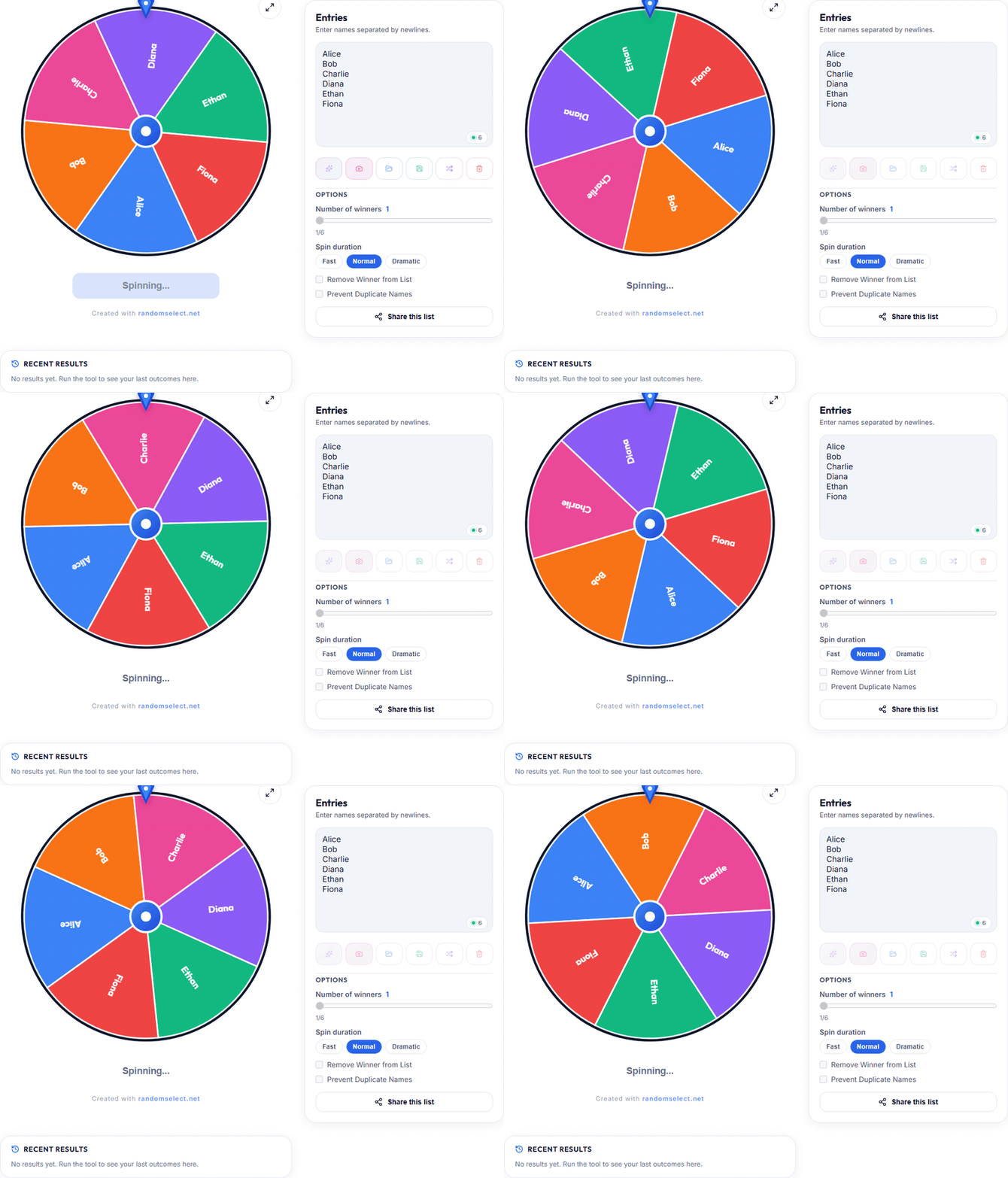
Quiet students get selected. A volunteer system reliably surfaces the confident. Random selection finds people who did not intend to volunteer — which is the entire reason for doing it.
You stop managing appearances. There is a real cost to seeming to favour particular students, and it lands on the students who notice it. A draw is a fact rather than a judgement, which is a much easier thing to explain to a parent.
It saves the fifteen seconds. Not the main reason, but the one that makes the practice sustainable. The moment where a teacher hesitates over who to call on is dead time that accumulates over a term.
Which Tool
Wheel of Names — visual, and the one students expect. Best where the announcement should carry weight: cold-calling, reading rotations, “who presents next”. The spin gives the moment some weight, which is the point when you are trying to make participation feel voluntary rather than punitive.
Lucky Draw — a flat list, one winner, minimal ceremony. Better for repeated routine draws where speed matters: register round, homework check, “who has not read yet this week”.
The choice matters less than it appears — both draw from the same source and are equally fair. Pick on the basis of how much ceremony the moment deserves. The wheel takes longer per draw, which adds up over a fast rotation through thirty names.
Preparing the List
Type it before the lesson. Five minutes the night before, or three wasted minutes in front of thirty students who get to watch you type and object to the list.
Use full names where there are duplicates. Two students called Alex means the draw cannot distinguish them, and a near-miss looks like rigging even when it is not.
Save it. Saved lists keeps up to five, works in your browser without an account, and syncs across devices if you sign in. Save one list per class per term rather than per lesson.
Remove absentees first. Otherwise a name comes up, you skip it, and the pool was not the published pool.
Making It Land
Say it is random. One sentence — “everyone has exactly the same chance” — removes most of the pre-emptive anxiety. Students who believe the mechanism cannot be influenced do not spend the question planning their escape.
Do not turn it into a quiz. There is a line here. Random selection works as a way of distributing attention across a lesson, not as a device for putting individuals on the spot. If a student who cannot answer looks relieved rather than ashamed, you have it right.
Vary the stakes. Cold-calling for everything is exhausting and will eventually produce a student who stops participating entirely.
Let a student run it. Hand the device over for the draw. They watch the whole sequence, they can see the list was not edited mid-lesson, and they stop needing to trust that you rigged it. This is thirty seconds and it removes a suspicion you would otherwise manage all term.
Beyond Recitation
Group formation. Group Maker removes the “can I work with Sam” negotiation. Pot balance keeps sizes even for anything graded.
Task and role assignment. In project work, some roles are popular and some are not. Task Matcher pairs people with roles and reports anything unassigned rather than dropping it.
Seating. Classroom Seater works better as a weekly rotation than as a one-off arrangement.
Scoring. The Scoreboard turns accumulated points into something visible, which converts a series of small tasks into a competition people care about.
Where It Stops Working
Skill-dependent tasks. Random selection for something requiring an aptitude will sometimes pick the wrong student. Assign those deliberately; randomise the rest.
Very small pools. Drawing one of three names is visibly close to a decision. Drawing one of thirty is convincing. With small groups, use a rotation instead.
Twice in one lesson. Two draws in five minutes reads as punitive. Once a lesson, varied, works.
As a substitute for preparing. The teacher who draws a name and then has nothing to ask that student has randomised their own failure.
When it becomes mandatory selection. Replacing all volunteering with draws removes students’ agency entirely. The strongest version of this practice mixes the two — volunteering for the easy questions, drawing for the ones that need asking.
Equal Chance Is Not Equal Outcomes
Worth being precise, because it comes up. A class of thirty will not have every student chosen equally often over a term, and someone will notice.
That is not a flaw to hide. Uniform is not balanced — over a long enough run the gaps close. Say so honestly rather than constructing a rotation by hand, which produces the appearance of fairness without the substance.
If the requirement is genuinely balance across a term, use a rotation. It is a different tool for a different job.
Explaining the Fairness
Some students ask how you know it is actually random, and they deserve a real answer.
The short version: it uses the browser’s cryptographic random generator rather than a formula-based one like Math.random(), which is predictable — its internal state can in principle be reconstructed to anticipate results. The fairness page has the mechanism, including why picking 1 of 40 names needs rejection sampling rather than a scaled random number.
What Actually Happens
Pick the activity you already do most often — the register check, the reading rotation, the first cold call of the day — and randomise that one for a fortnight.
The objection, when it comes, will rarely be “that isn’t random”. It will be a student who wanted to be picked and was not. That is a separate conversation and a useful one to have, because it means the room has stopped treating participation as a competition to win.
Nobody has to explain that to them.