Football associations have drawn lots for centuries, which tells you something about how much organisers trust chance. It also tells you where they learned to stop trusting it.
Random draws solve one specific problem — the appearance of favouritism — and they introduce another: random outcomes do not respect ability. Knowing which is which is most of the work.
Where Randomisation Earns Its Place
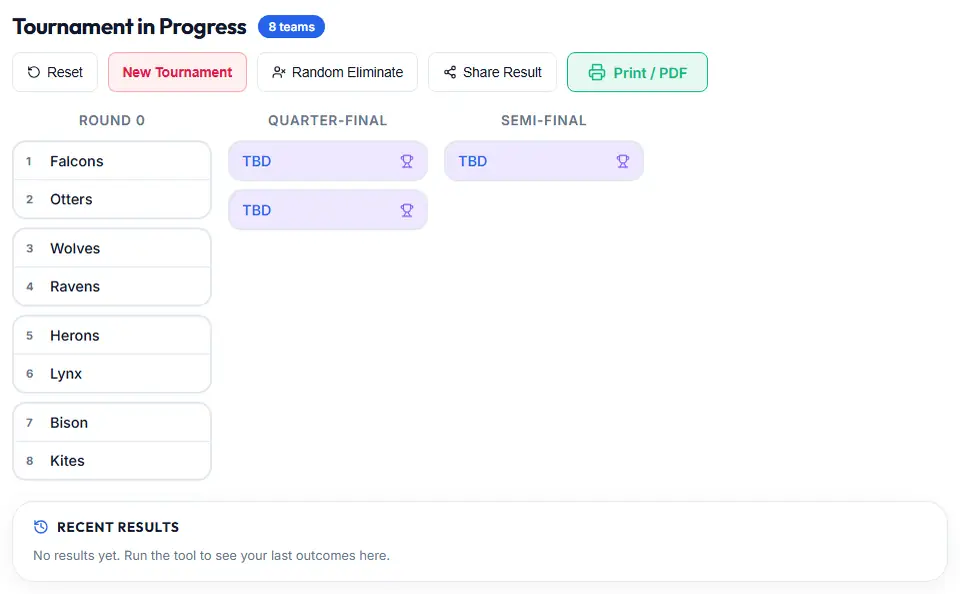
Seeding a knockout bracket. The strongest case. Seed strength cannot be judged reliably, and an organiser who picks it is open to challenge regardless of whether the choice was reasonable. A draw removes the argument entirely.
Splitting squads when you cannot rank players. If you genuinely do not know who is strongest, random groups are more honest than invented rankings. If you do know, randomising produces bad teams and a coach who is frustrated with the tool.
Rotating captaincy. Where the role is mostly social rather than technical, rotation is fair and takes the sting out of a twenty-year-old complaint.
Settling dead ends. Two volunteers tied for the last spot, or a fixture time nobody will agree on. A draw resolves it in five seconds and neither party can blame the other.
Where It Fails
Anything skill-dependent. Random selection for the first team, a specialist role, or a scoring role will sometimes pick the player who is least suited. Randomness is uniform; “best striker” is not.
Team balance. This is the big one. A random split of a squad with one exceptional player and twenty similar ones puts that player in one group and makes every match against that group a foregone conclusion.
The fix is to randomise within skill bands, not across the whole squad. If you have three groups and no ability data, seed the one or two players you know are strong into separate groups first, then draw the rest.
Player rotation minutes. A draw is not a rotation. It produces some players playing well and others sitting out for three weeks running, which is a fairness complaint waiting to happen. If minutes matter, use a published rotation schedule and draw only the parts you actually need randomised — the order, or the reserve pairing.
Long-term selection. Randomising membership or a permanent position is a decision dressed as a process. Nobody accepts “the draw said so” as a reason for a season.
Practical Approach
Draw on camera or with the list visible. A bracket draw in a clubhouse should be reproducible. Screen-record the draw with the full entrant list in frame — the list is the evidence that everyone was in the pool, and it costs nothing to show it.
Keep the record. Save the screenshot with the date and the entrants. Arguments about seeding do not survive a picture.
Use the right tool for the job. For a bracket, the Tournament Bracket handles elimination rounds directly, including byes for an odd number of entrants. For a flat list, Lucky Draw picks one name. The Wheel of Names works when you want the group to see the draw happen.
Remove duplicates before drawing. Two clubs entered as “Rovers U16” and “Rovers U16 (B)” will produce a bracket where the same club appears twice and the draw looks broken. Same for players registered under both “J. Smith” and “James Smith”.
Youth Sport
Two uses are genuinely worth it here, and one is not.
Random draw for captaincy and duties is good: children learn that outcomes can be impartial, and the practice of accepting that is the valuable part.
Random draw for playing time is a mistake. Children do not understand probability in the way adults assume, and being told “the draw said you sit out” lands badly. A visible rotation sheet is both fairer and better received.
Parental complaints are usually reduced by a random draw, but not because it prevents them. It prevents the conversation about whether the coach was playing favourites, which is the conversation that actually escalates.
Documenting for Disputes
Three things, and you have covered the dispute:
- The entrant list at the time of the draw
- A screenshot or recording showing the list and the result together
- The date, and the rules you were applying
If your association has a written rule about how selection happens, follow it even when it seems unnecessary. A procedure followed consistently is a stronger defence than an apparently fair decision with no record.
What Underpins the Draw
The draws use the browser’s cryptographic random source rather than Math.random(), which is predictable — its internal state can in principle be reconstructed to anticipate results. For a bracket that decides a season, that distinction is the whole question. The fairness page has the full explanation.
Summary
Use a draw for seeding, for dead ends, and for duties where the role is social. Do not use it for anything that depends on ability, for long-term selection, or for anything a child will remember being excluded from.
Ready to seed a bracket? Open the Tournament Bracket and enter your entrants. No account needed.