The wheel of names is one of the most versatile random selection tools available online. Whether you’re a teacher looking to randomly select students, an event planner running a giveaway, or just someone who needs to make a fair decision, the random name picker wheel can help.
According to a 2024 survey by the National Education Association, 78% of teachers who use digital random selection tools report improved student participation and perceived fairness in classroom activities. The wheel of names has become the go-to tool because it combines transparency with engagement — students can see exactly how the selection works, eliminating any suspicion of bias.
What is a Wheel of Names?
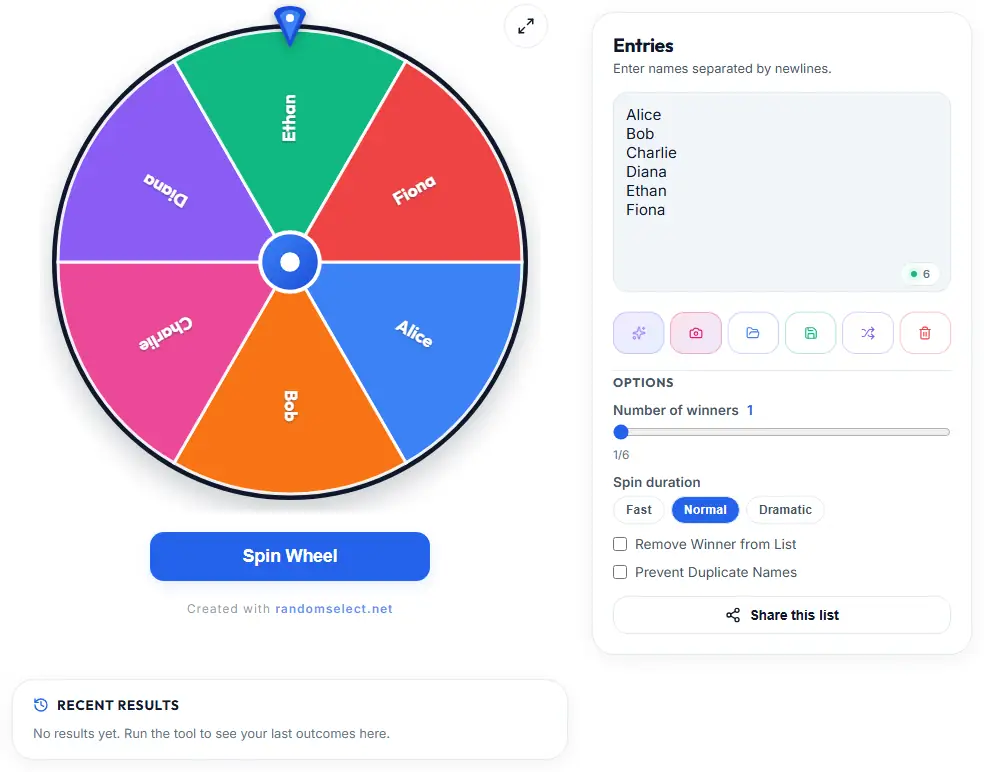
A Wheel of Names is a digital spinning wheel that randomly selects an item from a list you provide. Unlike traditional random number generators or name pickers, the wheel provides a visual, exciting experience that keeps participants engaged.
The form descends from the prize wheel and the “wheel of fortune” game-show format, both of which work on the same principle: a slow resolution gives a result more weight than the same result delivered instantly. The anticipation is real and it is why the wheel holds a room’s attention in a way a name appearing in a list does not.
Why Use a Wheel Instead of Other Methods?
- Weight: a slow resolution gives the result more presence than the same name appearing instantly
- Visibility: the full participant list is on screen during the spin, so the pool is visible rather than asserted
- Engagement: people stay with the process, where a bare list output gets ignored
- A shared reference point: everyone saw the same thing, so later questions are about the result rather than about what they think they saw
Two honesty notes. The animation is not what makes the draw fair — the outcome is fixed before the wheel moves, and the guarantee comes from the random source, not the spin. And a wheel is slower per draw, which matters if you are working through thirty names quickly; use a flat picker for register rounds and save the wheel for moments that deserve it.
How to Use Wheel of Names
Step 1: Enter Your Names
Start by typing or pasting your list of names into the wheel. Each name should be on a new line. You can add as few as 2 names or as many as 100+ names.
Pro tip: Use emojis in your names to make the wheel more visually interesting! Adding 🎓 for students, ⭐ for VIPs, or 🎮 for gamers makes the wheel more fun.
Step 2: Customize Your Options
Before spinning, consider these options:
- Remove winner after selection: Prevents someone from winning twice in a row
- Prevent duplicates: Ensures fair selection across multiple rounds
- Sound effects: Adds audio feedback during spinning for more impact
- Theme colors: Match your event or classroom branding
Step 3: Spin the Wheel
Click the SPIN button and watch the magic happen. The wheel will gradually slow down and stop at a random name. That’s your winner!
For best results, consider recording the spin if you’re running an official giveaway. This adds an extra layer of transparency and gives you content to share on social media.
Best Practices for Fair Selection
For Teachers
The Wheel of Names is perfect for classroom management:
- Calling on students: Replace “who wants to answer?” with a fair spin
- Assigning seats: Randomly assign seating arrangements for fresh perspectives
- Forming groups: Create random teams for projects. Worth knowing the limit, though: a random split produces teams of mixed ability rather than balanced ones. Seat your strongest students into separate groups before drawing, and the draw handles the rest.
- Choosing presentation order: Fair order for student presentations
- Selecting topics: Let the wheel decide which subject to review first
For Event Organizers
Make your events more exciting:
- Prize giveaways: Let winners spin the wheel for bonus prizes
- Door prizes: Random selection for attendance prizes
- Activity selection: Choose game participants fairly
- Raffle draws: Use the wheel as a visual raffle draw tool — audiences love watching the spin
For Teams and Families
Decision-making made fun:
- Chore distribution: Randomly assign household tasks
- Who pays?: Fair way to decide who drives or pays for dinner
- Game night: Select teams or game order without arguments
- Movie night: Let the wheel pick what to watch
What Changes in Practice
Rather than numbers nobody can check, the effects you will notice in a real classroom:
- Participation widens. The quiet students get picked, because the volunteering habit stops paying. This is the largest effect and it arrives within a fortnight.
- Disputes drop. Not to zero — a student can still object — but they stop being about your judgement, because the reasoning is visible.
- Coverage improves. You find out what the quiet half knows, which volunteering never tells you.
- Time barely changes. Building the list is the real cost, so this only pays off once you save the roster and stop rebuilding it each lesson.
- Selection order matters. Presentation order and reading rotations are the high-value uses; cold-calling for everything is not.
Advanced Features
AI-Powered List Generation
Don’t want to type out all the names? Use our AI feature! Just tell our AI what kind of list you need, and it’ll generate it for you instantly.
Examples:
- “Generate 20 European countries for a geography quiz”
- “Create 15 fun team names for a corporate event”
- “List 30 common English vocabulary words for grade 5”
Save and Load Lists
Save your frequently-used lists and load them with one click. Perfect for:
- Class rosters for multiple periods
- Team names for recurring events
- Guest lists for weekly activities
- Prize item lists for repeated use
Wheel of Names vs Other Random Selectors
| Feature | Wheel of Names | Random Picker | Excel RAND() | Random.org |
|---|---|---|---|---|
| Visual appeal | High | Low | None | Low |
| Easy to use | Very | Very | Medium | Medium |
| Share results | Yes | Limited | No | Yes |
| Mobile friendly | Yes | Yes | No | Yes |
| Free to use | Yes | Yes | Requires Excel | Yes |
| Multi-language | 12 languages | 1-3 languages | N/A | 1 language |
| AI fill | Yes | No | No | No |
| Save lists | Yes | Limited | Yes | No |
| Cryptographically secure | Yes | Varies | No | Yes |
Common Mistakes to Avoid
- Too many entries: Keep your list under 100 items for best visual results
- Reusing without resetting: Always reset between rounds if you removed previous winners
- Rushing the spin: Let the wheel spin naturally — don’t try to stop it early
- Not recording: For official draws, always screen record for transparency
- Ignoring mobile users: If participants will view results on phones, test the mobile view first
Tips and Tricks
- Keep lists balanced: Too many items make the wheel hard to read — segment into multiple rounds
- Use clear names: Avoid nicknames that might be confusing
- Test first: Do a practice spin before your actual selection
- Share results: Use our built-in share feature to announce winners
- Add media: Customize the wheel colors to match your brand or event theme
Conclusion
The wheel of names is more than just a random selector — it’s a tool that brings fairness, excitement, and transparency to any selection process. Whether you’re in a classroom, an office, or hosting an event, the random name picker wheel transforms ordinary random selection into an engaging experience.
The reason visible randomness persuades is not statistical — it is that a process nobody witnessed is indistinguishable from a biased one. When people watch the wheel spin and see the full list of names on screen, they have evidence rather than an assertion. That is also why recording the draw matters more than which tool produced it.
One honest limitation: the result is fixed before the animation starts, and the spin plays toward it. That is deliberate — it removes any possibility of influencing the outcome by timing your tap — but it does mean the animation is theatre over a value already determined. Anyone who might object to the result should be told the mechanism rather than shown the spectacle.
Try it at RandomSelect.net. No signup, no account, works on any device, and the fairness page explains exactly how the draw is generated.
Additional Resources
- Classroom Random Selection Research: The National Education Association provides resources on equitable classroom participation strategies at NEA Classroom Management.
- Cryptographic Randomness: Our wheel uses the Web Crypto API for truly unpredictable results. Learn more at the Mozilla MDN Web Crypto API documentation.
- Giveaway Legal Guide: For official contest compliance, the FTC provides guidelines at FTC Advertising and Marketing.
Ready to spin? Try Wheel of Names free →