Every teacher knows the challenge: you need to select a student for an activity, but the method you choose sends subtle messages about fairness, bias, and equity. Calling on the same eager participants creates learned helplessness in others. Alphabetical ordering feels mechanical. Even voluntary approaches can feel exclusioning.
Random selection for teachers solves this problem—not just once, but every day, for every type of classroom activity. This guide explores how modern digital tools transform classroom selection from a administrative burden into an engagement opportunity.
The Psychology of Fair Selection in Education
Why Perceived Fairness Matters
Students are remarkably perceptive about fairness, and they read the method rather than only the outcome. Whatever a teacher intends, students experience as follows:
- It was random — nobody was singled out, so there is nothing to interpret
- It felt chosen — the reasoning is invisible, so the absence of a reason gets filled in with suspicion
That second reading is the one that damages a classroom, and it is why a visible, inspectable draw often lands better than a careful human judgement even when the judgement was fair.
The effect is not subtle in practice: introduce a draw into a class that previously used volunteering, and the students who never answered start preparing. Revert to volunteering and the preparation stops within a fortnight. Whatever explains that, it is a change in what students are optimising for.
What “Fair” Means to Students
Fairness in selection has multiple dimensions:
Equal probability: Every student has the same chance of being selected Transparency: The selection method is visible and verifiable Consistency: The same method is used across similar situations Independence: Past selections don’t affect current probabilities
When digital tools meet all four criteria, students accept outcomes more gracefully and focus on the activity rather than the selection process.
The Bias We Don’t Notice
Even well-intentioned teachers introduce bias through:
- Recency effect: Selecting students you just spoke to
- Halo effect: Choosing high-performing students for high-visibility activities
- Horn effect: Avoiding students who’ve been disruptive
- Similarity bias: Preferring students who remind us of ourselves
Random selection tools eliminate all of these unconsciously. When selection is visibly random, there’s nothing to question.
Traditional vs Digital Selection Methods
Comparison Table
| Method | Fairness | Speed | Engagement | Records | Consistency |
|---|---|---|---|---|---|
| Paper slips in hat | Medium | Slow | Low | None | Variable |
| Dice rolling | High | Medium | Low | None | High |
| Alphabetical | High | Fast | None | None | Perfect |
| Volunteer | Low | Fast | Varies | None | Low |
| Digital wheel | High | Fast | High | Optional | High |
| Digital list selector | High | Instant | Low | Yes | Perfect |
Why Digital Tools Win
Digital random selection tools offer advantages that physical methods can’t match:
Speed: Instant results with no setup or cleanup Engagement: Visual spinning creates anticipation and excitement Verification: Screen recording provides proof of fairness Record-keeping: History tracking ensures balanced coverage Consistency: Same method every time, eliminating variability
Real Classroom Efficiency Gains
The measurable gains are modest in absolute terms, and worth being honest about that:
- Time: the draw itself is instant, but building the list is the real cost. It pays off only once you save the roster and stop rebuilding it each lesson.
- Disputes: they drop substantially, because the reasoning is visible. Not to zero — a student can still object, they just cannot object to an invisible process.
- Participation: rises noticeably the first few weeks, then settles. It does not stay at its peak, and expecting it to is how people conclude randomisation stopped working.
- Coverage: this is the one teachers consistently mention. Students who would never volunteer get selected, and you find out what they know.
Top Random Selection Tools for Education
1. Wheel of Names - The All-Purpose Classroom Tool
The most versatile tool for classroom use. A spinning wheel displays names, and physics determines the winner.
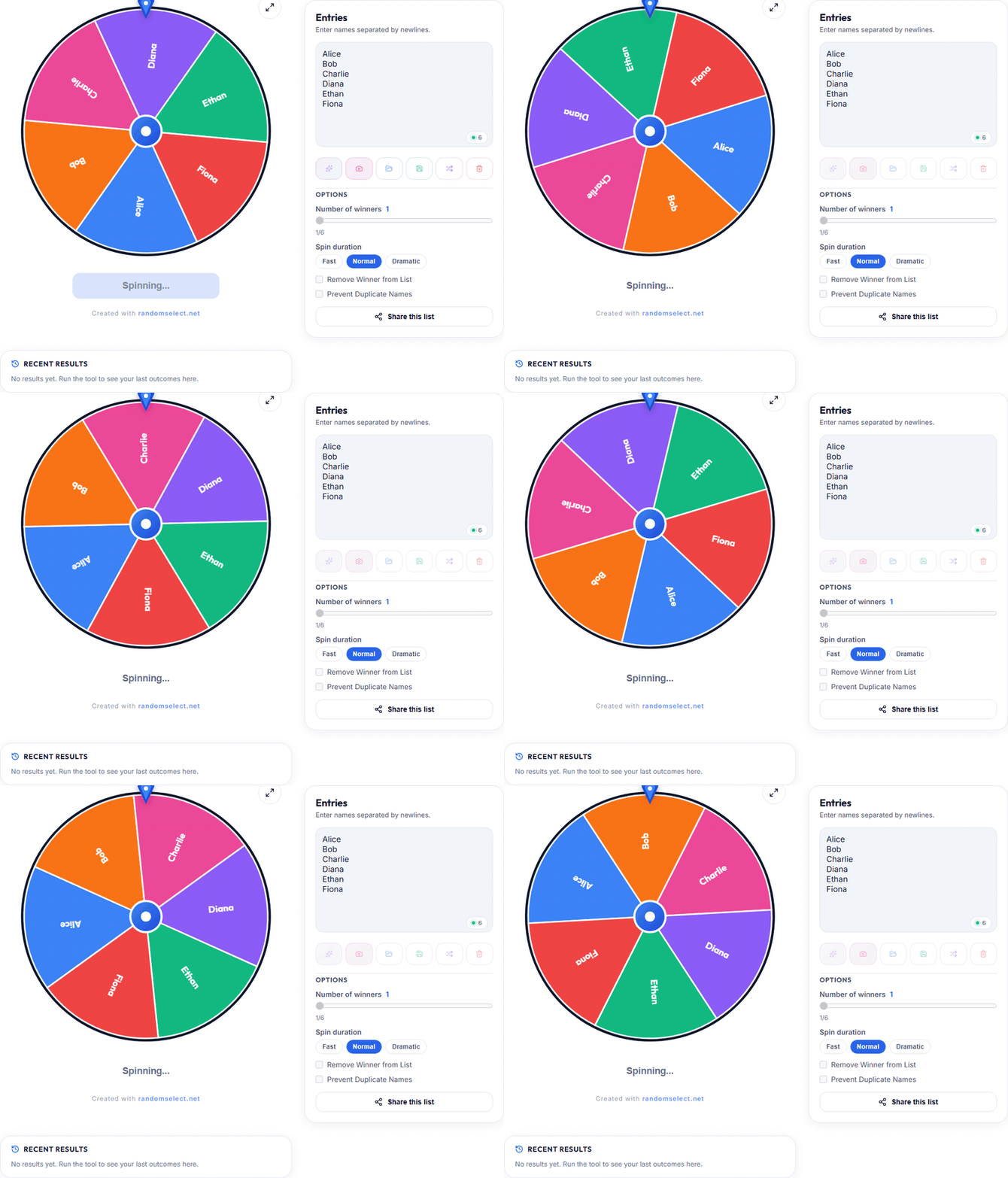
Best uses in classroom:
- Daily warm-up selection
- Student presentation picks
- Group formation
- Competition team assignment
- Vocabulary or problem demonstrations
Why teachers love it: The visual spinning creates genuine excitement. Students watch with anticipation, making even routine selections feel like events.
Key features:
- Save multiple class lists
- Customize colors and sounds
- Remove-after-selection for multiple winners
- AI-powered list generation for practice/demo
2. Group Maker - Team Formation Made Fair
Specifically designed for creating balanced groups. Specify group sizes and let the tool split your class.
Best uses in classroom:
- Lab group assignment
- Project team formation
- Discussion group creation
- Competition team division
Why teachers love it: No more “can I work with my best friend” negotiations. Random assignment eliminates social pressure and ensures diverse groupings.
Key features:
- Define exact group sizes (2-10 per group)
- Ensure even distribution
- Save and reuse class configurations
- Automatic balancing for equal skill distribution
3. Task Matcher - Fair Assignment Distribution
For distributing tasks, responsibilities, or assignments fairly across a group.
Best uses in classroom:
- Classroom job rotation
- Homework assignment distribution
- Equipment responsibility
- Chore or duty scheduling
Why teachers love it: Every student gets equal chance at preferred tasks, and the randomness removes negotiations about who gets the “good” assignments.
Key features:
- Define task categories
- Set assignment frequencies
- Track who has been assigned what
- Prevent clustering of undesirable tasks
4. Quick Scorer - Competition Tracking
For classroom competitions, game days, or any multiple-round activities requiring score tracking.
Best uses in classroom:
- Math bee tracking
- Spelling competition
- Academic Olympics
- Game-based learning activities
Why teachers love it: Keeps scores fair and visible, and the random selection keeps competitions moving without teacher mediation.
Key features:
- Multiple player/team support
- Running score display
- Round management
- Win tracking over time
Implementation Guide: Integrating Random Selection
Week 1: Introduction Phase
Day 1: Demonstrate the tool to the class
- Show how the wheel works
- Explain why you’re using random selection
- Invite questions about fairness
Day 2-4: Use for low-stakes selections
- “Let me pick someone to help me clean up”
- “Who wants to hand back papers”
- Casual, everyday selections to normalize the tool
Day 5: Use for slightly higher-stakes
- “Let me pick someone to present their answer”
- Students start to understand this is now part of class routine
Week 2: Establishment Phase
Monday-Thursday: Full integration
- Use for all classroom selections
- Students can request to see the list (transparency)
- Reference past selections if questions arise
Friday: Reflection
- Ask students: “How do you feel about random selection?”
- Address any remaining concerns
- Adjust implementation if needed
Ongoing: Optimization
- Save class lists for quick access
- Build history awareness (“you’ve been selected 3 times this month”)
- Adjust frequency based on class dynamics
- Solicit student feedback monthly
Common Implementation Challenges
“The wheel picked the same person twice” Response: “That’s exactly what random means—sometimes people get picked more than once over time. The probability is always equal for each spin.”
“Can I have a turn to spin?” Response: “The wheel spins, not a person—it’s the tool making the selection. But I understand the appeal of the wheel!”
Student refuses to accept selection Response: “I understand it’s disappointing, but I need you to know this was completely random. The wheel doesn’t know who you are or whether you wanted to be selected.”
Success Stories from Real Teachers
High School Math Teacher, Chicago
“I used to spend 10 minutes every class period deciding who presents. Now I spin the wheel in 10 seconds and spend that time actually teaching. My students actually remind me to ‘spin the wheel’ when I forget—they’ve turned it into a game themselves.”
Elementary School Teacher, Austin
“I have one student who never raises his hand. When I started using the wheel, he got selected for a classroom job and his face lit up. For the first time, he felt like he had an equal chance at opportunities. Now he’s more engaged even in non-selected activities.”
Special Education Teacher, Boston
“My students with behavioral challenges used to fight over who gets selected. Since I started using a random picker, those conflicts disappeared. There’s no one to blame or resent—the computer chose, not me.”
Music Teacher, Rural Georgia
“Running a random selection for ensemble tryouts used to be awkward. Now I spin the wheel in front of everyone, and there’s no question about fairness. Students accept the results because they saw the selection happen.”
Best Practices for Maximum Benefit
Do: Explain the Purpose
When students understand why you use random selection, they accept it more gracefully. Explain:
- “I use this because I want everyone to have equal chances”
- “This way, no one can say I’m playing favorites”
- “Random selection teaches us that everyone deserves a fair shot”
Don’t: Overuse It
Using a random picker for every single selection feels mechanical. Mix methods:
- Use random selection for high-stakes, visible selections
- Use volunteers for casual, low-stakes moments
- Use strategic selection when there’s a teaching reason (e.g., calling on someone you know understands to model good work)
Do: Maintain Transparency
Show the list when requested. Let students see all the names. Explain how the randomness works. Transparency builds trust.
Don’t: Track Publicly in Embarrassing Ways
While record-keeping is fine, avoid calling out “Sarah has been selected 5 times this week” in ways that might embarrass students. Use data privately to ensure balance.
Do: Allow Graceful Acceptance
Teach students how to respond when selected (or not selected). Model good acceptance behavior yourself.
Don’t: Use It When Legal Issues Apply
For any selection with legal implications (scholarship recipients, competition winners with prizes), ensure your selection method meets the specific requirements of that program.
The Technology Behind Educational Random Selection
How Randomness Works
Random selection tools use a cryptographically secure generator rather than a plain formula-based one. The distinction is worth being precise about, because both are called “random”:
A formula-based generator such as Math.random() is deterministic. If you know the algorithm and can observe enough outputs, you can work out its internal state and anticipate what comes next. A cryptographically secure generator is also technically deterministic, but it is seeded from hardware entropy and designed so that observing its outputs does not reveal the state.
For a classroom, that difference matters less than it does for a prize — nobody is going to attack your RNG to win a turn. It is still the right answer to give, because students do ask, and “it uses your browser’s secure random generator” is a sentence that closes the conversation.
Uniformity is the other half. Picking 1 of 6 is easy. Picking 1 of 40 requires rejection sampling — draw, and if the value falls in the incomplete final bucket, discard and redraw — otherwise the first name comes up slightly more often than the last. The fairness page covers the implementation.
Verification and Trust
You can show a student this, and it is more convincing than asserting it:
- Draw several times from the same list
- Show that the results vary — the tool has no memory of previous draws
- Point out that every spin is independent: a long run of one name says nothing about the next
The last point is the useful one to teach. Students usually suspect that the tool is “due” to pick someone, which is the gambler’s fallacy and a genuinely interesting idea to demonstrate rather than correct.
A second demonstration works well: draw with the list visible on screen, so the pool is evident rather than asserted.
Data Privacy Considerations
What to look for in any tool you paste a class roster into:
- No account required for basic use — an account is a data relationship for something you may use once
- Lists stored locally — saved lists in your own browser, rather than uploaded by default
- No third-party sharing — worth checking the privacy policy if you are handling real student names
- AI generation is opt-in — a prompt-based list feature sends your prompt to a language model on someone else’s infrastructure. Fine for placeholder names, wrong for anything containing student details
- Works after the page has loaded — useful when the school wifi is unreliable
Photographic list import is OCR, and OCR occasionally misreads a name. Read the imported list before you draw with it.
For sensitive educational contexts, this privacy matters.
Random Selection for Teachers: FAQ
Is random selection fair?
Yes, when properly implemented. Random selection means every person has an equal probability of being chosen. For educational purposes, this is the definition of fair.
Does random selection help introverted students?
Yes. Introverted students often don’t volunteer, meaning they get fewer opportunities. Random selection ensures introverts get equal chances to participate, present, and be recognized.
What if a student never gets selected?
Over time, with large enough classes and consistent use, selection should balance out. Keep records to ensure no student is systematically excluded. If someone hasn’t been selected in many sessions, note it and consider adjusting your list or method.
Can I use random selection for grading?
Random selection for participation credit (who answered, not how well they answered) is fine. For actual assessment of work quality, selection must be non-random—grading should evaluate specific work fairly, not randomly.
How do I handle students who doubt the tool?
- Show the complete list
- Explain how random selection works
- Offer to run multiple selections
- Demonstrate that the same person doesn’t always win
- Point out that doubt about fairness is natural, but the tool is designed to be unbiased
Can random selection tools handle large classes?
Yes. Most tools handle hundreds of names. For very large classes (100+), consider splitting into groups first, then selecting from groups, or using a text-based selector instead of a visual wheel.
Is it okay to use random selection for high-stakes decisions (e.g., scholarships, awards)?
For internal classroom decisions, random selection is fine. For formal awards or scholarships with official requirements, check the program rules—some require specific judging criteria or documentation that random tools may not provide.
Try Random Selection in Your Classroom
RandomSelect.net’s tools are free, require no signup, and work on any device. Start with one tool—Wheel of Names is the most versatile—and integrate it into your daily routine.
Within a month, you’ll notice:
- Less time spent on selection decisions
- Fewer student disputes about fairness
- Better engagement from traditionally quieter students
- More equitable distribution of opportunities
Are you a teacher using random selection tools? Share your experiences, tips, and success stories with fellow educators in the comments below.