A decision wheel is a device for stopping deliberation. That is its whole mechanism, and it works better than almost anything else at stopping deliberation.
It also works at hiding the fact that you had already decided, which is where it goes wrong. Both things are true, and knowing which one you are doing is most of the skill.
When It Works
Genuine indifference between real options. You do not know where to eat and you do not care. This is the ideal case and it is more common than people admit.
A group that cannot converge. Ten people, three restaurants, twenty minutes gone. A draw ends it in two seconds and nobody can blame the outcome.
Deciding the order rather than the outcome. Who goes first, which project to start, what to play next. The order matters, so randomising it removes an unfairness rather than avoiding a decision.
Delegating a decision you do not want to own. Sometimes the honest move is to say “we’ll decide at random on Friday” and mean it.
When It Is a Mistake
A real preference you are avoiding. This is the common one, and the wheel will find it for you. If you rebuild the wheel every time it lands on the option you disliked, you have not made a decision — you have built a machine that reports your existing preference and then resents it.
The tell is re-spinning. If you are on your fourth spin, you have your answer and it is the option you did not want.
Anything with asymmetric consequences. A coin flip is between “drive” and “you drive”. A wheel between “quit the job” and “stay” is not the same kind of object, and a result you cannot live with is not a decision you made.
Anything where you cannot reverse it. Randomness is efficient. Efficiency is not what you want when the outcome must also be good.
Decisions other people will live with. Draw your own dinner. Not your team allocation, not your curriculum, not anything where the outcome is imposed on someone who did not spin.
The Reveal
There is a genuinely useful thing here, and it is worth stating properly.
Setting the choice aside briefly reveals what you actually prefer. Not what you should want — what you want. If the wheel lands on the option you were hoping to avoid, that is information: something about it is genuinely unattractive, and you have now discovered that cheaply.
This works best with custom labels. A wheel with two options — “do it” and “don’t” — resolves a decision you have been circling for weeks. So does “order” versus “cook”. Two arbitrary labels is a decision procedure, not a novelty.
Building One That Works
List every option you would actually choose. Then remove the ones you would never pick. A wheel containing options you would refuse regardless wastes spins and undermines the result, because part of you knows the outcome was never going to be acceptable.
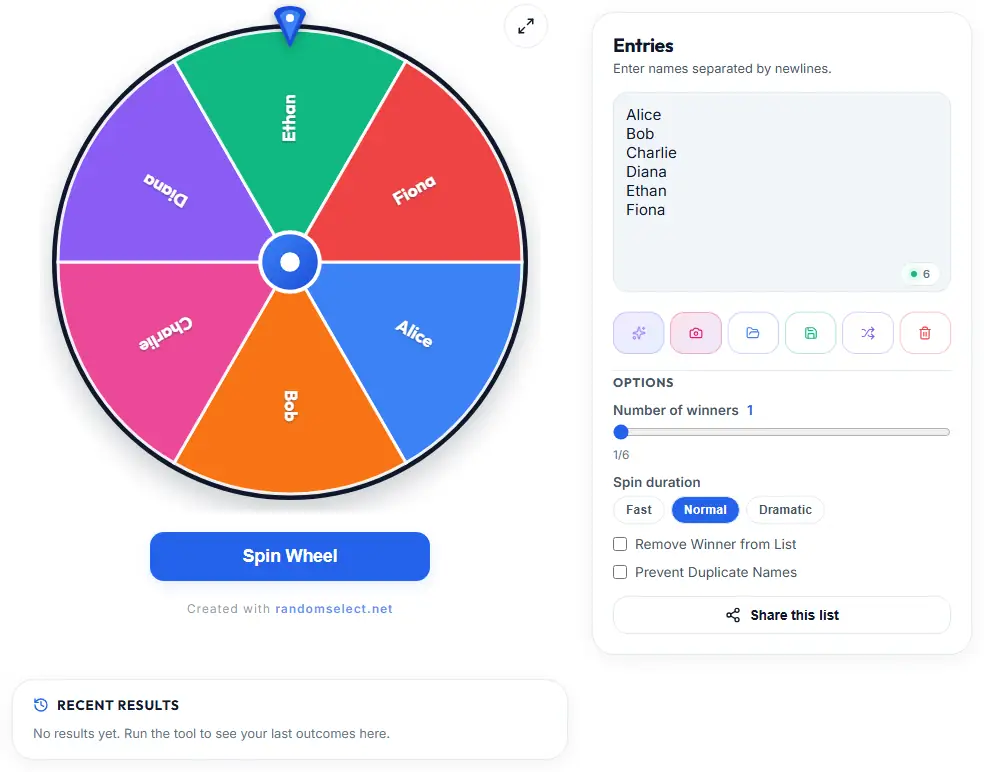
Name actual things, not categories. “Italian” leads to a second decision. “The place on the corner” ends the matter. The wheel works best when the options are commitments.
Cap the spins. Decide in advance that three is the maximum. This sounds trivial and it is the single most useful habit, because it forces the point at which you accept a result or make a real choice. Neither is bad; a twentieth spin is neither.
Do not add a re-spin option. It feels like it preserves agency. It does the opposite — it guarantees the wheel can be used until it produces something you like, which removes the reason to accept anything.
Use it in front of others for group decisions. Watching the wheel resolve something removes the entire class of argument about who chose.
Wheels Worth Building
The lunch wheel. Six options, three spins maximum, no re-spin. Note that “leftovers” belongs on it — a wheel of only desirable options is not a decision aid.
The order-of-work wheel. Which project to start, which task to do first this session. Randomising order rather than content is where this is at its best, because order fairness is exactly the thing people fight about without noticing.
The two-option wheel. Yes/no, do it/don’t, stay/move. Custom labels on the coin or the wheel, and a hard three-spin cap.
The “something else” wheel. If your usual choice is “I will end up doing the same thing”, a wheel of five alternatives forces a real change. Best used with a genuine commitment to the result.
What the Spin Is
The result is fixed before the animation starts; the animation plays toward an outcome already chosen. That is deliberate and it is worth understanding — because it means the outcome cannot be influenced by timing, tapping at the right moment, or claiming you called it.
The value comes from crypto.getRandomValues(), the browser’s cryptographically secure generator, rather than Math.random(), which is deterministic and can in principle be reconstructed to predict the next result. The fairness page explains the mechanism.
The Honest Summary
A decision wheel is good at stopping a debate and bad at making a decision. It produces a random outcome, and a random outcome is not the same thing as a good one.
Used where the options genuinely do not differ in quality, it is genuinely helpful. Used where one option is quietly much better, it is a way of avoiding finding out — and it will find out for you.
If you cannot accept any outcome the wheel could produce, the decision is not ripe, and no tool fixes that. Make the call, then build a wheel for what to do next.