Random selection tools earn their place in a classroom for one reason: they remove the moment where a teacher’s hand hovers over a name and a few students mentally check whether they are about to be called. Randomising removes the reaction, and with it the friction.
That is the whole benefit. It is worth remembering when evaluating the options, because “which tool is best” is usually the wrong question — the useful one is “which tool fits this activity”.
Choosing a Tool
| You want to… | Use |
|---|---|
| Pick one person for a question | Wheel of Names |
| Pick one person from a list, no theatre | Lucky Draw |
| Split the class into teams | Group Maker |
| Assign tasks, chores, or roles | Task Matcher |
| Track points between teams | Scoreboard |
| Assign seats by a rule | Classroom Seater |
Wheel of Names
The visual one, and the one students expect. It suits activities where the announcement matters as much as the outcome: cold-calling, reading rotations, “who presents next”. The spin gives the moment some weight, which is the point when you are trying to make participation feel voluntary rather than punitive.
Cost to be aware of: it takes longer than a text draw. For a fast rotation through thirty names, that adds up.
Lucky Draw
A flat list, one winner, minimal ceremony. This is the better choice for anything you will repeat — a register round, a homework check, a “who has not volunteered yet”. It is faster than the wheel and just as fair; both draw from the same crypto.getRandomValues() source.
Group Maker
Splits a class into teams, either by number of groups or by fixed size. It has options beyond equal division, and two of them matter in a classroom:
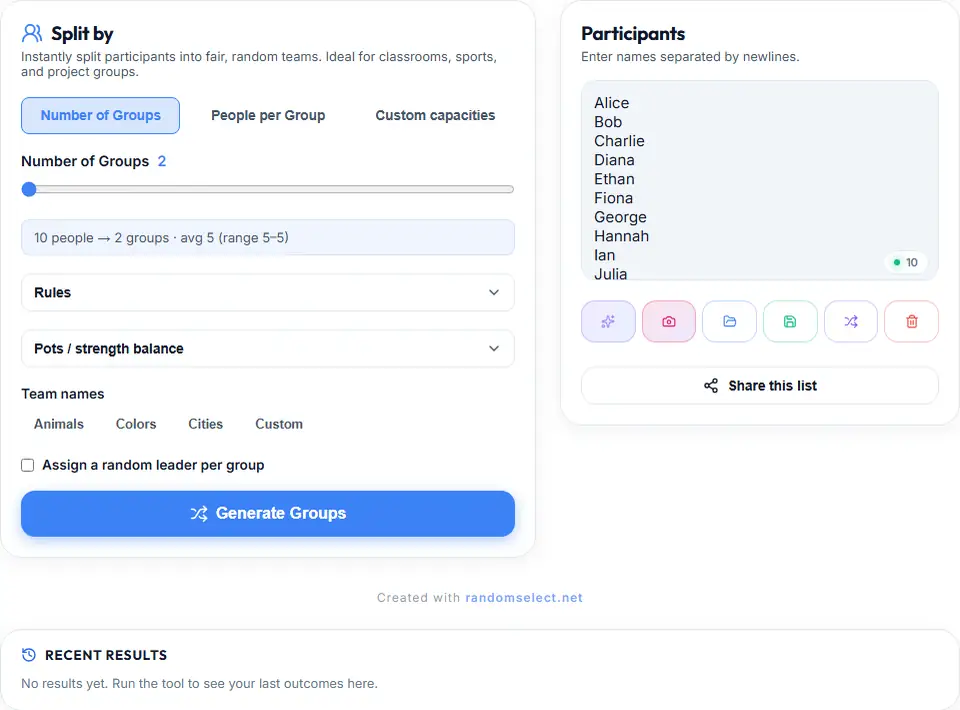
- Capacity per team — set a maximum size rather than an exact count, so you can round down without ending up with a group of one
- Group labels — name the teams, which turns an anonymous split into something students can hold onto (“Blue Team, your reading is chapter four”)
Balance matters more than randomness for groups. A random split of a class with very different abilities produces one unworkable group about one time in three. The Group Maker cannot see ability, so pair randomisation with a quick self-rating if the work is group-dependent.
Task Matcher
Pairs names with tasks or people with people. Useful for routine distribution — cleaning duty, lab partners, presentation order — where the recurring complaint is that the same student always ends up with the same job.
It removes the appearance of favouritism, which is genuinely the harder part to solve. A student who notices they have done the washing-up six weeks running has a grievance; one who knows the rotation was fair does not.
Scoreboard
Tracks points across teams. Straightforward, and its value is mostly motivational rather than computational — visible scoring converts a series of small tasks into something with a scoreboard, which people find considerably more engaging.
Classroom Seater
Assigns seats according to a rule: alphabetical, random, or in rotation from where they sat last time. Rotation is the useful one over a term — it stops the same cluster of students sitting together for months without anyone objecting.
Setup Mistakes Worth Avoiding
Building the list live. Typing thirty names while the class waits wastes the moment. Prepare the list beforehand, or import it from a photo.
Not saying what happens after the draw. Announce whether you draw again, remove the winner, or move on. Deciding mid-activity is what creates the “do it again, that wasn’t fair” cycle.
Using the wheel for everything. Its charm wears off, and it is slower. Reserve it for moments that deserve it.
Forgetting to involve students. The strongest variant of any of these: let a student operate it. They watch the whole sequence, they can see you did not influence it, and they stop needing to trust the result.
What You Do Not Need
There is no account to create, nothing to install, and no limits on how many draws you run. Everything on this page works immediately in a browser, which matters when you are setting up five minutes before the bell.
A Note on Fairness
Random does not mean unbiased. If your list has twenty girls and eight boys, a fair draw still picks mostly girls — the tool is random, the pool is not. When composition matters, randomise within groups rather than across the whole class.
The underlying method is worth understanding once: RandomSelect draws using the browser’s cryptographic random source rather than Math.random(), which is predictable. The fairness page has the full explanation, and it is a short read.
Start With One
Do not adopt all six. Pick the activity you do most often and randomise that one for a fortnight. If it works, add the next.
The Wheel of Names is the usual starting point, and it is free to use with no sign-up.