“Why do I always get the bins?” is a complaint about fairness, not about bins. The task is not the problem; being visibly chosen for it is. Random assignment dissolves that specific grievance, because nobody can point at a person and say the manager picked them.
This works in shared flats, offices, classrooms, and volunteer groups for the same reason: it moves the decision from a person who might want something to a process that cannot.
What Random Assignment Does and Does Not Fix
Be clear-eyed about the limits, because overselling this is how the technique loses credibility.
It fixes the appearance of favouritism. This is the real value. A rotation nobody can argue with removes a persistent source of friction.
It does not make tasks equal. Random assignment gives everyone an equal probability, not an equal workload. “Bins and recycling” takes fifteen minutes; “deep clean the fridge” takes an hour. If your task list is lopsided, random rotation will feel unfair even though it is mathematically fair — because people notice the hours, not the odds.
The fix is to make the task list comparable before you rotate, not to rotate more often.
Setting It Up
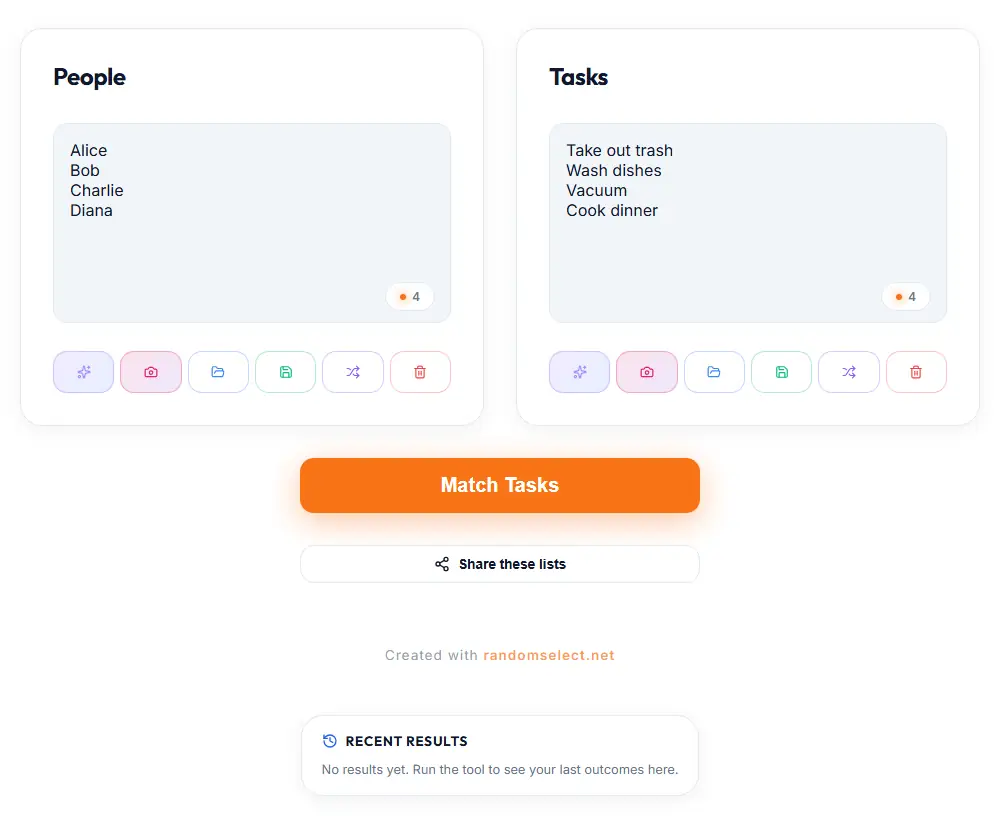
List the people. One name per line. Use full names where there are two people with the same first name, since duplicates in the list will skew the draw.
List the tasks. Also one per line, phrased as an instruction rather than a category: “take out recycling”, not “kitchen”.
Match. Task Matcher pairs them and shows the result as a list you can read out.
Uneven Numbers, Honestly
What happens when the counts do not match is worth thinking about, because the default is not always what you want.
More tasks than people. Every person gets one task. The remaining tasks are unassigned, and the tool shows that rather than hiding it. Do not quietly drop them — put them on a separate rotation, or reduce the task list to match the headcount before drawing.
More people than tasks. Some people get nothing. In a volunteer group, that is fine and even welcome. In a shared flat where the bins still need doing, it is not: the unassigned task has to go somewhere, and you should decide where rather than let the algorithm imply the work vanished.
A better pattern for both cases is a cycle: save your two lists, and re-run the match each period. Over a few weeks everyone receives roughly the same set, which is what people actually mean by fair.
Saving the Lists
This is the part that makes it stick. Re-typing names and tasks every week is what kills a rotation.
Save the people once. Save the tasks once. Each period you open the tool, load both, and draw again. The saved lists feature stores up to five, works without an account in your browser, and syncs across devices if you sign in.
Set a fixed day and time. A rotation tied to a trigger — cleaning day, start of term, first Monday of the month — stops feeling like a one-off gesture.
When Random Is the Wrong Choice
Random assignment is genuinely bad at three things:
- Skill-dependent tasks. If one task needs a qualification, randomising guarantees sometimes that the wrong person has it. Assign by competence and rotate everything else.
- Recurring effort. A task that takes an hour every week should be owned by one person, not rotated — the constant re-onboarding costs more than the inequity.
- Anything with a deadline and a dependency. If one task must happen before another, sequence them instead of pairing them.
For Teams
In an office the framing matters. “I assigned this at random” and “the tool picked” are not the same message to an employee, and the first is a management claim while the second is a fact anyone can check.
The strongest version is to make it visibly random: run the draw in front of the team, with the list on screen. There is no need to ask for trust when the mechanism is inspectable.
You can read how the draw works on the fairness page — the short version is that it uses the browser’s cryptographic random source, so nobody can predict or steer the result.
For Shared Flats
The version of this that works best is a weekly rotation with a small rule: whoever drew the bins this week is exempt from next week’s most annoying task.
That last rule is not random, and it should not be. Randomness removes the argument about who got what; the exemption removes the argument about whether it was really random. Keeping both is what makes a shared chore system survive a few months.
Start This Week
Write down the people and the tasks. Load them into Task Matcher, save both lists, and run it every Sunday for a month. Then look at whether anyone still asks who is doing the bins.
Usually they stop after the second week.