The pattern is familiar in every classroom: the same few students answer, a few more answer when the material is easy, and the rest develop a reliable way of appearing elsewhere. Nobody is misbehaving. The system is simply rewarding a particular kind of student.
Replacing “who wants to answer?” with a draw changes the incentive. That is the whole mechanism, and most of its effect arrives in the first fortnight.
The Actual Problem
Volunteering has a cost and not everyone can pay it.
The cost is being wrong in front of peers — which for a student who struggles with the material, or who speaks a second language, or who has been wrong in front of this class before, may be high enough to never be worth it.
So participation becomes a habit rather than a skill. The confident volunteer early, the semi-prepared student when the question is easy, everyone else silent and listening. That is not a motivation problem, and treating it as one does not work.
What Random Selection Fixes
Equity. Every student has the same chance. In a class where cultural expectations shape who speaks up, this matters more than the fairness argument alone — some students’ non-participation is a norm they are following, not disengagement.
Engagement. “It will not be me” becomes “it could be me.” Attention follows quickly and stays for longer.
Authentic assessment. Drawn answers show what students know rather than what they rehearsed. This is genuinely useful information for you — it surfaces misconceptions that volunteering hides.
Skill building. Students who know they may be called articulate their thinking in advance. The benefit compounds over a term.
Choosing the Tool
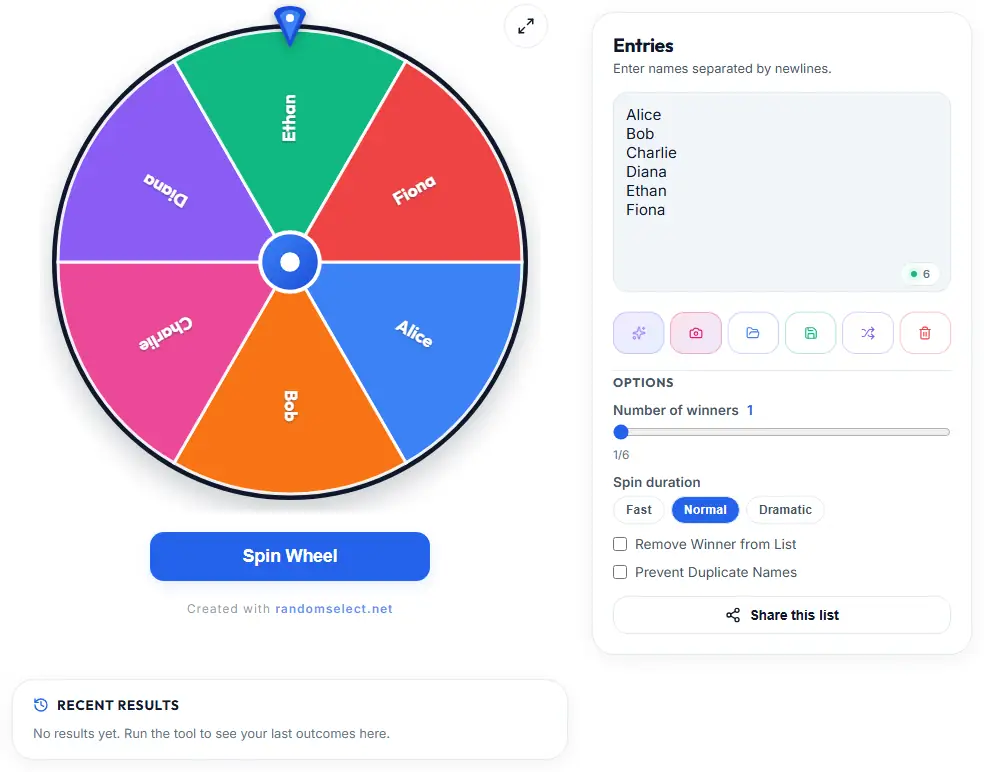
Wheel of Names — visual, and what students expect. Best where the announcement should carry weight: cold-calling, reading rotation, “who presents”. The anticipation is part of the pedagogy.
Lucky Draw — flat list, one winner, no theatre. Best for anything repeated where speed matters: register check, homework reminder, “who has not read yet”.
Group Maker — for project groups, lab partners, discussion teams. Removes the negotiation entirely.
The choice matters less than it looks — all draw from the same source. Pick on how much ceremony the moment deserves.
Cold Calling, Done Carefully
Cold calling has a deserved reputation. It works when the risk is low and fails when it is not.
Announce the method before you start. “I will draw for every question today” is a sentence that changes the whole lesson. Students who know the mechanism cannot be influenced stop spending the question planning their escape.
Give think time. Name the student, then wait. Five seconds of silence feels unbearable to you and adequate to them. Skipping it is the single most common way a fair cold call becomes an unfair one.
Let them pass once. A student who says “I don’t know, can someone else take it?” should be allowed to without penalty. Without that escape route, participation becomes a risk students manage by disengaging entirely.
Judge effort, not correctness. If a wrong answer draws warmth, the mechanism stops working and you get the performance of confidence instead.
Other Applications
Socratic seminars. Draw the opening speaker for each round. Preparation rises across the whole group because the opener changes each time, and the person who opens a round gets interrupted less than one who opens the tenth.
Peer review. Draw review pairs. Feedback from someone you did not choose is more honest, which is the entire basis of peer review.
Exit tickets. Draw three students to share their reasoning on the way out. Not a quiz — they have already written it down, which removes the exposure that makes cold-calling hard.
Group work. Group Maker with pot balance for anything graded. Seat the strongest students before drawing.
Making It Land
Say the mechanism. One sentence, out loud, every time: “everyone has exactly the same chance.”
Do not turn it into a quiz. Random selection works as a way of distributing attention across a lesson. Used as a device for putting individuals on the spot, it produces exactly the anxiety you were trying to remove. The test is simple — does a student who cannot answer look relieved or ashamed?
Vary the stakes. Cold-calling for everything is exhausting and will eventually produce a student who stops participating altogether.
Let students operate it. The strongest version: hand the device to a student for the draw. They watch from the start, they can see the list was not edited mid-lesson, and they stop needing to trust that you rigged it. Thirty seconds, and it removes a suspicion you would spend the term managing.
Preparing the List
Type it before the lesson. Thirty names typed live takes three minutes in front of thirty students who get to object to the list.
Full names for duplicates. Two students called Alex cannot be distinguished by a draw, and a near-miss looks like rigging.
Save it. Saved lists keeps up to five, works without an account, syncs across devices if you sign in. One list per class per term.
Remove absentees before drawing. Otherwise you skip a name and the pool was not the pool.
The Limits
Equal chance is not equal outcomes. Over a term, some students get picked more. Uniform is not balanced. Say this honestly if asked; the gaps close over a long run, and if balance is the requirement, use a rotation instead of a draw.
It cannot supply competence. A draw will sometimes pick the wrong student for something requiring particular knowledge. Assign those deliberately.
It does not work on small pools. Drawing one of three names is visibly close to a decision.
It does not equalise work. Random rotation of unequal tasks produces an unequal result that is mathematically fair. Make tasks comparable first.
What Usually Happens
The first fortnight there is silence after you draw, because students are watching to see what happens. Then it settles, and what you get is a class where the quiet half is occasionally caught out — which is the point, and is much less threatening than it sounds when nobody has watched them decline three times.
A month in, the resistance tends not to be about randomness at all. It is a student who wanted to be picked and was not. That is a separate conversation, and a useful one.
The fairness page explains the mechanism, worth having ready for the student who asks how you know.