A coin toss settles a disagreement in two seconds. That is why it survived as a decision procedure for as long as there have been coins, and why it still works when better methods are available.
What changed is where the coin comes from. The physical one required being in the same room; now it does not. That is the substantive change, and everything else about this tool is smaller than it looks.
How the Flip Works
The coin is 3D and the result is fixed before the animation starts — the spin plays toward an outcome already determined.
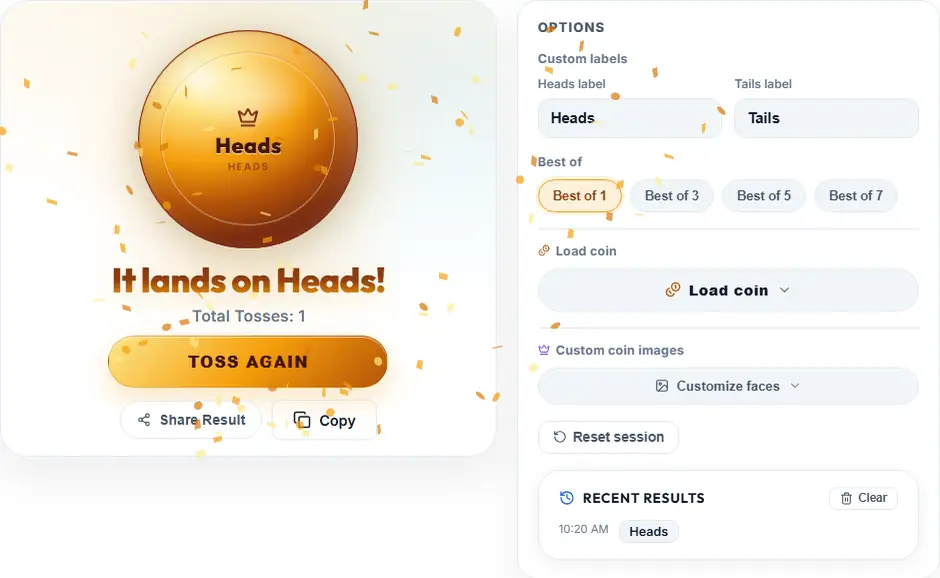
This is deliberate and it is worth understanding, because some people read the animation as evidence of manipulation. It is the opposite. Because the outcome is already decided, there is no input for anyone to influence: not timing your tap, not watching the rotation speed, not calling it. The visual is theatre over a value that is already fixed.
The value comes from crypto.getRandomValues(), the browser’s cryptographically secure generator, rather than Math.random(). That distinction matters more than it sounds: Math.random() is deterministic, so its internal state can in principle be reconstructed to predict what comes next. Each side is exactly 50%, and successive flips are independent.
The fairness page covers the mechanism.
Where a Physical Coin Is Genuinely Weaker
This is the counterintuitive part, and it is not close.
The method is a channel for influence. A real coin can be caught, rotated onto an edge, or re-flipped. Its result lands where the thrower intended. None of this concerns the coin’s balance — it concerns the person being in the loop, which is exactly the thing digital randomness removes.
A physical coin can be weighted. Not dramatically, but a worn or slightly imperfect coin carries real small bias, and a coin that has been flipped ten thousand times is measurably less fair than a new one.
Alternating flips are close to forced. If one person flips and another flips, the second party can call it. Over two flips this barely matters; over twenty, it is the whole game.
Where the physical coin genuinely wins: the sound, the tactility, and the fact that a coin on a table between two adults is something a suspicious person cannot argue with. Those are not trivial.
Using It
Custom labels. Heads and tails are not fixed — relabel them as yes and no, home and away, cook and buy, stay and go. Two arbitrary options with a spin between them is a decision procedure, not a novelty, and this is what makes the tool more useful than an actual coin.
Custom face images are supported too, for deciding between teams by crest rather than by name.
Best of N. The tool tracks a series and reports a winner, which removes the infinite-flipping problem entirely.
A running toss count. It keeps a total, which is a small useful reminder when you have been flipping a long time: short sequences mean nothing.
The Limits People Hit
A coin over 20 flips will not give 10 and 10. Randomness is uniform, not balanced. Expect runs, and expect them to be longer than feels right — three tails in a row on a fair coin happens about one time in eight. If you need an even split across a series, use Best of N rather than flipping until someone leads by one.
“Best of 3” is not fairer than a single flip. It is three flips, which means the same claim is true three times over, and the runs problem is worse.
When a Coin Is the Right Tool
Two parties, one binary outcome, no skill involved. Who drives, who pays, which half of the pitch. The conditions are narrow on purpose — the coin works because the options are genuinely equivalent.
A live deadlock. Its one advantage over every other method is that it resolves the argument and ends the discussion, because neither party chose the result. If the loser might have preferred a different method, it is the wrong tool.
Breaking symmetry. When two things are equivalent and you cannot decide, a flip beats a pros and cons list.
When It Is Not
A real skill difference exists. If one option is better, flipping wastes an advantage.
The result feels arbitrary to a person. If someone’s name is on one side and they get the short straw, “the coin said so” does not land the way a coin on a table does. Draw from a real list instead, with everyone watching — Lucky Draw for a single winner from a flat list.
It is a repeated decision about the same people. Flipping for a rota every week gives one person the short end four times. That is not bad luck, that is what independence means.
The outcome is irreversible or costly. Flips are for decisions you can afford to lose.
And the One Not to Use It For
Choosing a restaurant with a coin is a good way to end up somewhere you do not like. Flipping is efficient, and efficient is not what you want when the outcome has to be good as well as unbiased.
If the choice matters, make it. Use the coin where the two options genuinely do not differ in quality, and for nothing else.
Open the Coin Flip — no account, no install, works on a phone, which is where most real coin tosses now happen.