A session starts and someone cannot find the d20. This is a more common problem than it sounds, and it is entirely solved by not owning dice.
The virtual roller here throws physical-looking dice in 3D, on any device, with no account. It is worth understanding what it does differently from a real die — and where it does not differ at all.
What You Can Roll
Presets cover the standard tabletop set: d4, d6, d8, d10, d12, d20. The custom face field accepts anything from 2 to 100 sides, which covers percentile rolls and a lot of homebrew systems.
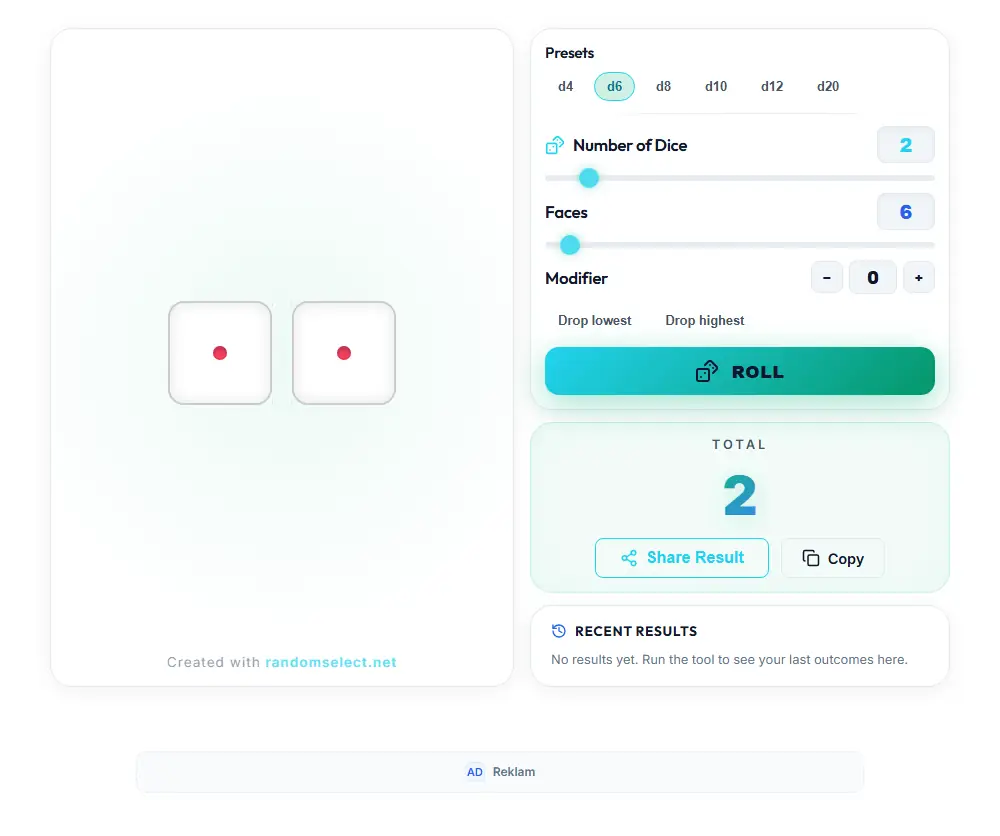
You can throw up to 12 dice in one roll and apply a modifier from −99 to +99 to the total. Set the modifier before you throw, so the result is not something you adjust afterwards.
The combination that matters most: several dice of one type plus a modifier covers almost every attack and damage roll in a standard RPG system, without a second tool.
How Fairness Actually Works
Two mechanisms, both worth knowing because “random” gets used loosely online.
A cryptographic source. The dice draw from crypto.getRandomValues(), the browser’s cryptographically secure generator. The alternative — Math.random() — is deterministic, so its internal state can in principle be reconstructed to predict future results. For a board game this is trivia. For anything with money or a reputation attached, it is the entire question. The fairness page has the full explanation.
Rejection sampling. When you ask for a uniform integer in a range that does not divide evenly, scaling a random float over-biases the low values. A d6 is straightforward; a d7 is not. The roller rejects out-of-range values and redraws, which is what makes every face exactly 1/N.
Each roll is independent of the last. A twenty does not make the next twenty less likely, and a run of sixes does not improve your odds.
Where a Real Die Is Actually Better
Being straight about this is worth it, because virtual dice are not strictly an upgrade.
A real die can be loaded. Manufacturing variations, wear, and rounded corners produce genuine small biases. A die that has been rolled ten thousand times is measurably no longer fair, and this is why loaded-die collectors exist.
The method is a channel for influence. A physical coin or die can be caught, rotated, or re-flipped. This is the practical weakness of real dice, and it has nothing to do with the die itself.
Tactility. A die you can pick up cannot be argued with by a suspicious player. It is not a trivial advantage, especially in person.
What a virtual die wins on is permanence: it does not wear, so it stays uniform for as long as the session runs.
For Tabletop Sessions
Screen-share the roll. This is what solves the “I swear I rolled a 20” problem. When the result appears on a shared screen for everyone at the same instant, there is nothing left to dispute.
Set the modifier before throwing. A modifier applied after the fact is a number someone chose.
Consider a minimum roll. Rolling a 1 on a d20 attack is valid and unhelpful. If your system re-rolls 1s on a critical check, do it in the tool so the record stays clean.
Keep the roll history. The tool keeps a record of recent throws, which settles the “that was definitely a six” argument without anyone having to remember.
For Board Games
Two practical notes for playing in person or remotely.
Announce the dice and the count before rolling. “Two d6 plus three” is unambiguous; “a seven” is not. Most disagreements about a digital roll are actually disagreements about what was rolled.
Have a fallback. If you are playing in person, keep the physical dice. The virtual roller is the answer to “I cannot find the d20”, not the answer to “we want to play differently”.
For Classrooms
Virtual dice are better than real ones for teaching probability, for reasons unrelated to fairness.
Throw twelve at once. Rolling 12 dice makes a distribution visible in a single action. Repeat a dozen times and students watch the spread narrow toward the expected value — an intuition that takes an hour of physical rolling to develop and about three minutes here.
Use the custom face count. A d4 is easy to reason about; a d100 gives fine granularity. Students can ask how the shape of the distribution changes as the number of dice grows, which is the actual lesson.
A useful exercise: have students predict the next roll before you throw it. Nearly everyone guesses “low” after a high roll. Then throw it. The point is not to be right — it is to show that no prediction beats any other, because each roll is independent. Dice make this vivid because the wrong intuition is so strong.
Etiquette, Briefly
Online: show the roll, state which dice you threw, and post the result rather than describing it.
In person with a phone: check with the table first. Some groups have strong feelings about a phone on the table, and asking costs less than the conversation that follows.
Try It
Open the Dice Roller. Pick your die, set a modifier, and throw — no account, no install, which matters when the session starts in two minutes.