Manual group formation has three predictable costs: ten minutes of instruction time, a negotiation nobody wants to have, and — this is the one that matters — a grouping that quietly reflects your own preferences from over the years.
Randomising removes all three, and introduces one problem you need to understand before you start.
The Problem That Makes People Abandon It
A purely random split of a class with uneven skills produces one unworkable group.
Not occasionally — reliably. One strong student lands in one group, and every task that group does becomes a foregone conclusion. Everyone notices within a day, and the conclusion drawn is that randomisation is naive.
The fix is to seat the two or three students you know are strongest into separate groups before drawing. The tool still does the shuffling; you simply remove the input it cannot handle. It takes thirty seconds and it is the difference between a practice that survives a term and one that quietly stops.
The Settings That Matter
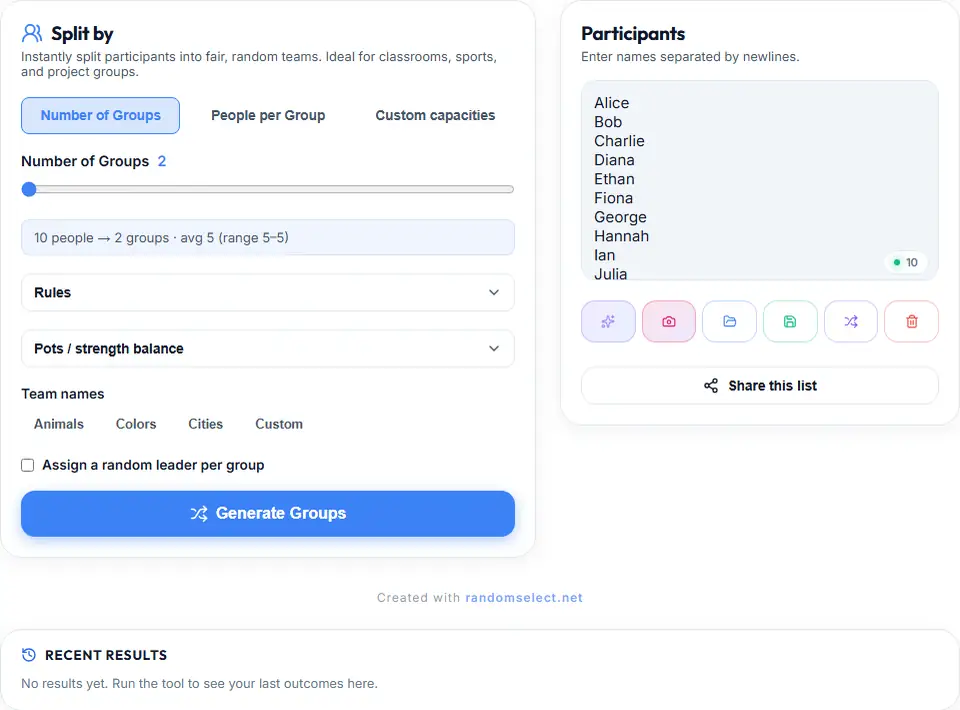
Number of groups versus people per group. The first divides as evenly as it can — thirty into five gives exactly six each. The second guarantees every group is the same size and calculates the count for you. For classroom work the second is the right default: a student left in a group of three because twenty-nine does not divide by four is a thing that gets remembered.
Random versus pot balance. Random is a pure shuffle, fair in the mathematical sense, but it can produce groups differing by one or two people. Pot balance deals participants into pots so sizes stay within one of each other. Use pot balance for anything graded or with a shared deliverable; random is fine for games.
Team names. Animals, colours, cities, or your own. This matters more than it sounds — “Group 1” and “Group 2” create an ordering that named groups do not, and named groups make referring to one afterwards natural.
Preparing the Roster
Type or paste it before the lesson. Building a roster live with thirty students waiting is how group work loses its first five minutes.
Deduplicate. “Rovers U16” and “Rovers U16 (B)” will land in different groups. So will two spellings of the same name.
Verify the count. The panel shows how many entries are loaded. A missing student cannot be added once groups exist, and they will find out in front of everyone.
Save the list. Saved lists keeps up to five, works in your browser without an account, and syncs across devices if you sign in. One list per class, reused all year, is the useful unit.
The Leftovers Problem
Worth planning for, because the arithmetic does not always divide evenly.
More groups than students. One person ends up in a group of one or two. Decide in advance whether to reduce the group count or let the small group exist — and let students know which you chose.
More students than groups. Fewer groups than you planned. Better to reduce the group count than to produce a group of nine.
A student left over entirely. With people-per-group mode, 29 students into groups of 4 produces one group of one. This is the most common visible awkwardness and it is solved by choosing a group size that divides your class, or by accepting a remainder group and naming it something unremarkable so it does not read as a punishment.
Random Is Not Balanced
Worth stating clearly because “random” gets used as though it means “even”.
Randomising produces even probability, not even quality. A random split mixes strong and weak students, which is right for peer learning and wrong for a task that requires everyone to contribute equally.
Three cases where you want something other than a flat random split:
Group projects with a shared grade. Random groups plus pot balance keeps sizes even. Consider assigning the grade as a group grade so a weak pair does not carry the whole result.
Peer teaching. A strong student paired with two weaker ones teaches more than two strong students paired together. Randomise, then look at whether any group has nobody who can hold the conversation.
Mixed-ability reading groups. This is the clearest case for stratification: sort by reading level first, then randomise within each level band so each group has one reader at each level but the composition of personalities is mixed. Randomising across the whole class produces groups where one person does all the reading.
When It Works Best
Short tasks. A single lesson or a single session. Group work with no defined output produces one member doing nothing, and no allocation method fixes that.
With a stated deliverable. Everyone produces something. The strongest version of group work gives each person a role; Task Matcher pairs people with roles and reports anything unassigned rather than dropping it silently.
Rotated. Different groups each cycle means students meet more people over a term. This is where the real benefit of randomising shows up — after six weeks, the friendship clusters from the start of term have dissolved.
With a check before you announce it. Read the resulting groups and confirm the headcounts. Announcing a grouping you have not checked is a correction you will have to make publicly.
Where It Does Not Help
Skill-dependent tasks. Randomising a lab technique assignment will sometimes put it with someone who cannot do it. Assign those deliberately; randomise everything else.
Long-term project groups. A group formed at the start of term is a group for months, and an unlucky split has nowhere to go. Use short cycles instead.
Groups that already work. If a pair collaborates well, randomising destroys it. That is not an argument against the practice — it is an argument for not using it on the two people who already work.
After a conflict. Randomising a class where a dispute just happened reads as a punishment, and produces resentment rather than resolution. Deal with the conflict first.
Getting the Result Out
Copy as text, print, or export as CSV or XLSX. Exporting is worth doing once per term — it gives you the rotation schedule for the weeks ahead without re-drawing, and it stops the “who was with whom” question resurfacing.
The Honest Summary
Random grouping is not equal grouping, and it is not balanced grouping. It is procedurally fair grouping, which solves the negotiation problem completely and the ability problem not at all.
Use it for short, low-stakes group work where the point is that nobody chose. Add the skill-band step for anything where the work needs to function. And check the result before you announce it.
The whole thing takes about fifteen seconds, and it replaces five minutes of the least valuable part of your lesson.