Teams form around people they already know. It is not malice, it is efficiency — working with someone you know well costs less. But the side effect is that a large organisation slowly divides into groups that only talk to each other, and the information that would have crossed the divide never does.
Random team formation is the blunt instrument for that. It works, and it also fails in one specific, predictable way that is worth understanding before you try it rather than after.
What Randomisation Actually Changes
It creates conversations that would not otherwise happen. This is the real effect and it is quieter than the marketing suggests. Two people from different teams meet as equals, which is a rare position — the usual reason people talk across a divide is that one of them needs something.
It removes the “A-Team” objection. Nobody can complain that the interesting project went to the same three people, because nobody chose them.
It distributes informal authority. A group with no designated leader tends to either wait for a volunteer or quietly let whoever speaks first decide. Assigning leadership randomly spreads that across the organisation instead of concentrating it.
It removes the negotiation. This is underrated. The ten minutes of “can I swap with Sam” costs more than the drawing.
The Problem That Makes People Quit
Here is the mechanic, and it is worth being blunt about: a purely random split of a team with uneven skills produces one unworkable group.
One exceptional engineer lands in one group. Every task that group touches becomes a foregone conclusion. Everyone sees it within a day. The conclusion drawn is not “randomisation was naïve” — it is “management does not understand this team”, and the tool gets blamed for a decision that was actually made by drawing from an undifferentiated pool.
The fix is to randomise within skill bands rather than across the whole team. Seat the two or three people you know are strongest into separate groups first, then draw everyone else. The draw still does the work; you just remove the input it cannot handle.
Group Maker has a pot-balance option that keeps group sizes within one of each other. That solves size imbalance, which is a different problem — worth using, but it does not know anything about ability, and no setting can.
Setting It Up
Build the roster first. Type it, paste it from a spreadsheet, or import a photo of the list. If you use photo import, read the result carefully — it is a genuine OCR process and it will occasionally misread a name.
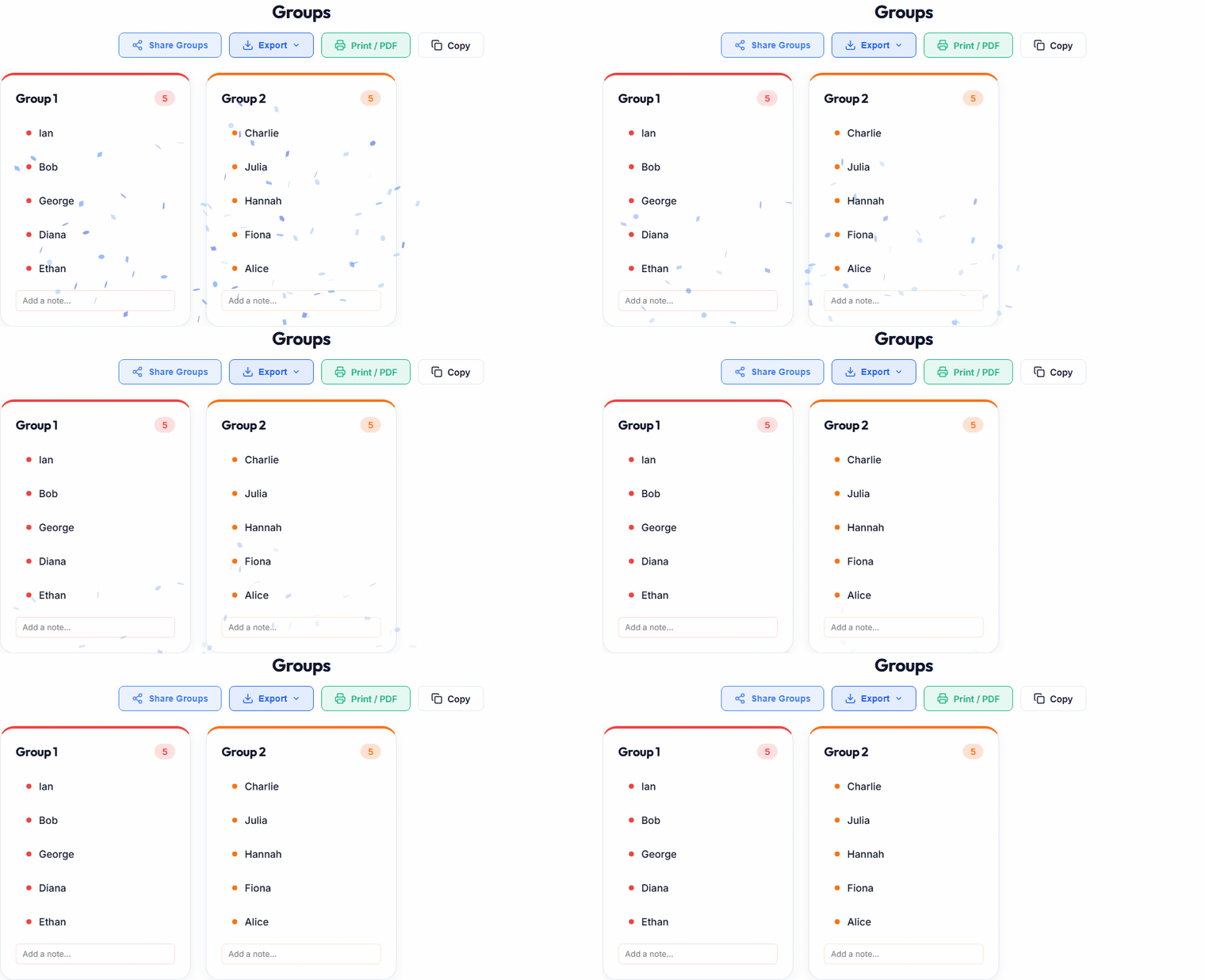
Verify the count before generating. The panel shows how many entries are loaded. A missing person cannot be added after groups exist, and the person who was missing finds out in front of everyone.
Pick the split mode carefully. “Number of groups” gives you exactly that many, dividing as evenly as it can — 30 into 5 gives 6 each. “People per group” guarantees every group is the same size and calculates the group count for you. The second is the right default for classroom work, where a leftover student is a visible problem.
Name the groups. Animals, colours, cities, or your own. This matters more than it sounds: “Group 1” and “Group 2” create an ordering, and named groups do not. They also make referring to one later natural — “the Falcons’ presentation” rather than “the second one”.
Turn on random leaders if the group has to produce something. Distributed authority stops one person deciding by default.
What to Do Afterwards
Export the groups as CSV or XLSX, or print them. A written allocation survives a corridor conversation that a spoken one does not.
Do not rearrange them afterwards. If you swap people to fix a balance problem, you have reintroduced exactly the judgement the draw removed, and now the draw is the thing people distrust. If a group genuinely cannot work, fix the split logic and redraw, in front of everyone.
The Version That Works Long-Term
A one-off random team exercise is a curiosity. The pattern that produces an actual change is repetition:
Rotate cross-functional pairs for defined work. A two-week pairing for one specific task, redrawn each cycle. The duration is short enough that an awkward pairing is tolerable, and the rotation means the same two people are not permanently fused or permanently excluded.
Draw from volunteers plus a random remainder. If people can opt in, let them — then draw the remaining places. Purely random draws for work people may prefer to avoid are received better when people at least chose to be in the pool.
Use it for the work nobody volunteers for. Cross-team workshops, the unglamorous project, the internal committee. Randomising the desirable work creates resentment; randomising the tedious work removes it.
For a Social Version
The lunch roulette works and it is worth doing, with one caveat: draw from across departments rather than letting people self-select. The whole value is that marketing ends up at a table with support.
Draw four, send them, and do not make it a competition. It becomes an obligation within a month unless people are given a genuine choice about whether to actually turn up.
What Underpins the Draw
Groups are formed with a Fisher-Yates shuffle, which does not modify the original list and produces an unbiased permutation. The random source is the browser’s cryptographic generator rather than Math.random(), which is deterministic and can in principle be anticipated. The fairness page covers both.
Try It
Open the Group Maker, paste your roster, and generate once. No account, no limits.
Before you do it for anything that matters, decide who gets seated where — the skill-band step. It takes thirty seconds and it is the difference between a tool people keep using and a tool people quietly stop trusting.