Team building earns a bad reputation for a reason: most of it is a trust fall, and everybody knows what a trust fall is. Random draws work better than that because they create genuine cross-silo contact without requiring anyone to be dropped.
They also fail in specific, predictable ways. Knowing those is the difference between an activity people remember and one they sit through.
The Failure Mode to Know First
A purely random split of a team with uneven skills produces one unworkable group. One strong person lands in one group, and every task that group touches becomes predictable. Everyone notices within a day and concludes the exercise was naive.
The fix: seat the two or three people you know are strongest into separate groups before drawing. The draw still does the work; you just remove the input it cannot handle.
This applies to every activity below that involves forming groups.
1. Lightning Challenges
Setup 10 minutes · Duration 30–45 minutes · Group any
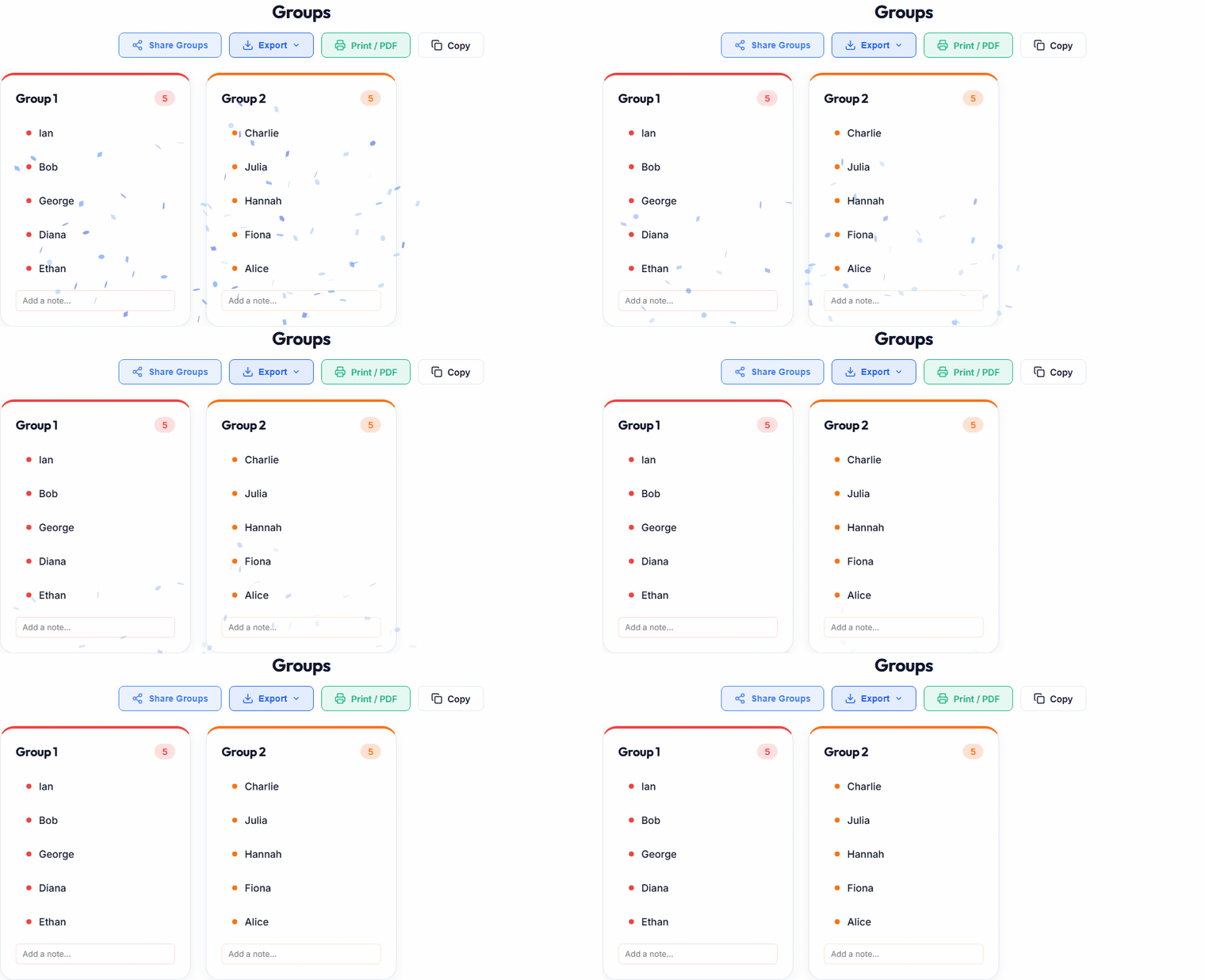
Everyone submits a challenge or problem. Group Maker draws teams of three or four, each team takes one challenge from the list, and has a fixed time to produce something. Present at the end.
Why it works: colleagues who never interact must produce something together under time pressure. There is no low-stakes option — the output has to exist.
Failure mode: challenges that require actual expertise. Make them things a three-person team can attempt in twenty minutes with what they already know.
2. Trivia With a Draw
Setup 15 minutes · Duration 45–60 minutes · Group 8+
Write questions beforehand. Build the wheel with team names and spin to decide who goes next, or use a flat draw to pick the answering team.
Why it works: people are not put on the spot personally, which is what makes volunteering-only formats exclude the quieter half of a room.
Failure mode: questions about company history nobody knows. Test them first, or the format becomes a way of demonstrating who has been there longest.
3. Skill Roulette
Setup 20 minutes · Duration ongoing · Group 10–30
Everyone writes down one thing they could teach someone else in fifteen minutes. Draw random pairs. The pairs meet — coffee, a call, a walk — and each teaches their thing.
Why it works: it produces cross-department contact with a stated purpose, which is the only kind of forced socialising that survives being tried once. There is also a genuinely useful side effect: hidden skills become visible.
Failure mode: it dies without a follow-up. Schedule the next round before the first one happens, or the pairs will not meet and the whole thing is forgotten by February.
4. Random Pair Programming
Setup 5 minutes · Duration 90 minutes · Group 6–16
Draw pairs. Give each pair a real task with a deliverable. Rotate at a set interval, so everyone ends up paired with someone they did not start with.
Why it works: pairs have a defined output, so it reads as work rather than an exercise. It is also the format most likely to produce a genuine operational improvement rather than a nice feeling.
Failure mode: pairing someone junior with someone senior on a task requiring experience. Same skill-band issue as everywhere else.
5. The Unpopular Choice
Setup 5 minutes · Duration 20 minutes · Group any
Each person writes down a preference they’d be happy to have decided by chance — which lunch, which meeting slot, which side of the project. Draw for each in turn. Everyone gets what they drew.
Why it works: people volunteer for this themselves, which removes the resistance that kills other formats. The commitment is real because they entered it.
Failure mode: people put things on the list they will be unhappy to receive. Say in advance that draws are final, and honour that even when the outcome is awkward — the trust in the format depends on it absolutely.
What Makes These Work
Announce the rules before, not after. Every activity above has a rule about draws being final. Stating it at the start is what makes it enforceable at the awkward moment.
Do not re-run draws. If someone does not like a result, that is the format working. Re-rolling converts a fair procedure into a search for a preferred answer, and everyone can see it happening.
Have people operate the tool. A draw the manager ran is asserted. A draw a colleague ran is witnessed. This is the single highest-value habit for making these activities land.
Keep them short. Forty-five minutes is right. An hour and a half of random activities is an afternoon people check their email through.
Do it quarterly at most. These are for breaking up a pattern. A monthly team-building slot gets treated as an obligation, and an obligation is worse than nothing.
What Does Not Work
Anything requiring trust. A random draw cannot manufacture vulnerability. Activities that require someone to lean backwards off a chair have nothing to do with how the teams were formed.
Anything with real stakes. Do not randomise who presents to the board or who gets the difficult client. That is a decision with consequences, and “the draw said so” is not an acceptable answer to someone who has to deliver it.
Anything that reveals performance. If the activity makes it obvious who contributed and who did not, it has stopped being a game and become an appraisal with confetti.
Anything requiring expertise the attendees lack. Groups of three cannot assess a contract. The output will be bad, and the failure will be attributed to the format rather than the brief.
What Underpins It
Draws use the browser’s cryptographic random source rather than Math.random(), which is deterministic and can in principle be reconstructed to anticipate results. Group formation uses a Fisher-Yates shuffle, which produces an unbiased permutation without modifying the original list. The fairness page covers both.
Nothing here requires an account, and groups can be exported as CSV or XLSX if you need the result to persist somewhere.
Start With One
Pick the activity that solves an actual problem. Skill roulette tends to have the longest tail because the pairs meet outside the event. Lightning challenges work best when you already know the teams will need to collaborate again.
Then set a recurring slot three months out — before you forget.