Most list generation is not a creative problem. It is typing. You have the content in your head and forty minutes of entering it ahead of you, and the content itself takes thirty seconds to think up.
The Fill with AI button in the toolbar removes the typing. You describe the list, it appears. It is a narrow feature, and knowing where the narrowness is matters more than knowing what it can do.
How It Works
The button sits in the toolbar of every list-based tool — the Wheel of Names, Lucky Draw, Group Maker, Task Matcher and others. Click it, type a prompt, and the generated entries replace what is in the field.
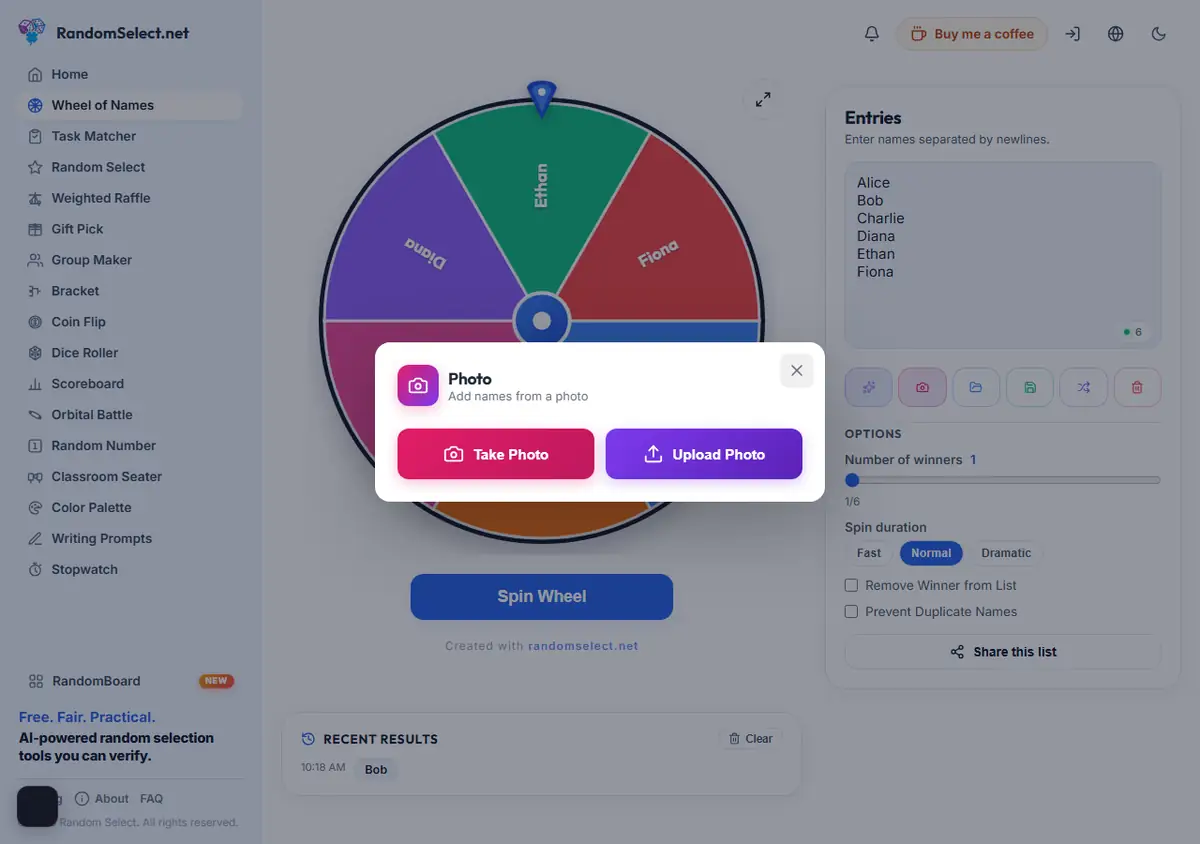
The output is plain text, one item per line, generated by a language model running through Groq’s inference service. It responds in the language you wrote the prompt in, so a Turkish prompt returns Turkish results and an Arabic one returns Arabic.
Prompts That Work
The pattern is consistent: be specific about quantity and category.
Good:
- “List the 81 provinces of Turkey”
- “30 common first names in Sweden”
- “15 European capital cities”
- “10 team-building activities for a remote team”
- “20 fantasy character names”
Weaker:
- “List some names”
- “Give me ideas”
- “Something for a quiz”
The difference is the first kind tells the model how many items and of what, and the second leaves both to guess. Vague prompts produce vague lists — often three items where you asked for twenty.
Because the system prompt is tuned for factual enumeration, count-based requests are the most reliable. A prompt asking for all 81 Turkish provinces gets all 81.
Where It Helps
Placeholder data for testing. Build a 200-name list, confirm your group settings and draw count behave, then delete it. This is the most common use and it saves the most time.
Deciding between options. Generate a realistic list, try two tools with it, see which you would rather show a class. The list is disposable; the decision is not.
Lists you would not type. Three hundred items by hand is a quarter of an hour of nothing. One sentence is a second.
Starting content. A list of quiz questions, a set of project ideas, a set of team names — these are a starting point you will edit, and generating ten items to expand into fifty beats writing ten.
Where It Should Not Be Used
Real participant lists. This is the important one. Generated names are not entrants. If you are drawing a prize and publishing the result, every name in the pool must belong to a real person who entered. A generated “Elif Yılmaz” is a plausible character, not a participant.
Lists you already hold. If the participants are in a spreadsheet, a photo, or a signup form, you have the real list. Generating an approximation of it is strictly worse than the thing you have.
Anything that needs to be verifiable. For a draw with weight, the pool has to be the pool you published. A generated list cannot be defended if anyone asks where a name came from.
Data you would rather not transmit. The prompt goes to a language model over the network. Treat it as though it would appear in a third-party log. Write “30 vegetables” and not anything containing participant details.
Practical Notes
Generated entries replace your current list. If you have typed something, save it first. Merging generated entries into a hand-built list would create duplicates and muddy provenance, which is exactly the ambiguity you do not want in a draw.
The output skews international and common. A model produces what it considers likely, so generated names lean toward names that appear often in text. If you need a list that reflects a specific local group, generated data will not get you there.
Regenerate rather than repair. If a list is nearly right but off in tone, adjust the prompt and run it again. Editing fifteen of thirty items is slower than one more attempt.
Do not assume factual completeness for anything critical. The model is instructed to return complete enumerations and usually does, but it is a language model rather than a database. For a list that has to be exactly right — legal entities, regulatory categories, anything you will be held to — verify it.
The Boundary in One Sentence
Use AI to build the list; use the tool to make the choice fair. Those are separate problems, and the draw is the one people are actually checking.
The draws themselves use crypto.getRandomValues() rather than the predictable Math.random(), so the selection is independent of how the list was built. The fairness page has the mechanism.
Try It
Open any tool, click the AI button in the toolbar, and ask for a specific list with a specific count. Start with something you could verify — a list of capitals, a list of categories — and see how it holds up before you rely on it for anything longer.