Running a contest is easy. Running one that survives a complaint is a documentation problem, not a randomness problem — the draw itself takes two seconds and the disputes are all about things that happened before it.
Publish the Official Rules First
Write the rules before the contest opens, put them somewhere linkable, and do not change them afterwards. Almost every dispute resolves into a question of fact: did the entrant meet the published condition?
Cover:
- What is being given away, and its approximate value
- Eligibility — age, location, and any exclusions including employees and their families
- Entry method — how to enter, and how many entries a person may have
- Entry period, with dates and timezone
- Selection method, described specifically enough that someone could reproduce it
- How the winner is contacted, the response deadline, and what happens if they do not respond
- The announcement date
- Any jurisdiction-specific requirements
That last one deserves attention. Rules for prize promotions vary by country and often impose obligations around free entry, official rules documents, and eligibility. If the contest is open internationally or you are a business rather than an individual, this is worth checking properly rather than assuming a template covers it. Treat this as a pointer, not legal advice.
Free Entry
The requirement most commonly stated for promotions is that entry be free and that a purchase must not improve someone’s odds.
That has a direct consequence for how you set up the draw. If extra entries can be bought, or earned through engagement in a way that amounts to purchase, you may need a different mechanism entirely — which is what skill-based contests and platform-native tools are for. Pure random selection and weighted entries are different legal categories, and they are not interchangeable.
The Weighted Raffle makes weights explicit precisely so a weighted contest can be described accurately rather than disguised as an equal-chance draw.
What to Avoid
Spinning a bottle. Not actually biased, but it reads as biased, and appearance is what matters at this point. There is no version of this that convinces anyone who has decided it is rigged.
Names in a hat. Genuinely hard to verify afterwards, and impossible to demonstrate that you did not look.
A spreadsheet formula run by one person. Perfectly adequate statistically and completely unverifiable — the person running it controls the input, and nobody else can check.
Platform-native comment pickers. Reasonable for small casual giveaways, and worth knowing they generally do not satisfy a rule requiring a specific published selection method.
The Process
Define it. Prize, entry method, closing date.
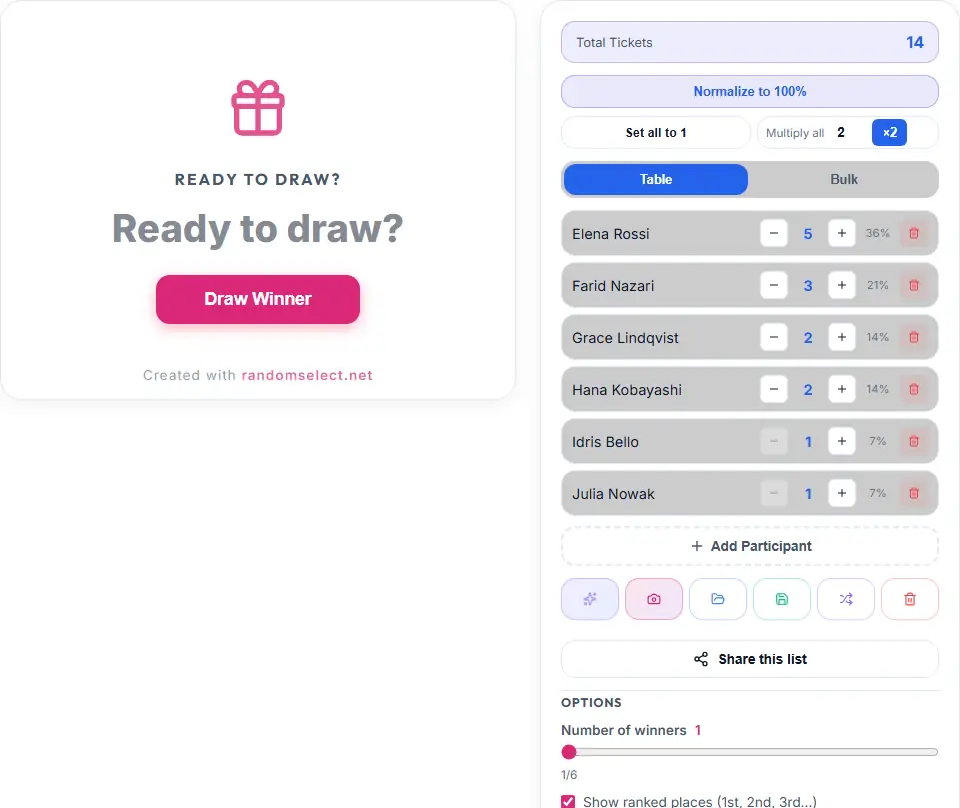
Collect entries with timestamps in one place. This is more important than it sounds — a handful of disputes are about whether an entry arrived before the deadline.
Clean the list before drawing. Verify eligibility, resolve duplicate usernames, and remove the entries that fail the published rules. Doing this before the draw rather than during it is what prevents the appearance of post-hoc manipulation.
Decide how duplicates are handled. One entry per person, or several? Lucky Draw has a duplicate-prevention option that collapses repeats to one. Turn it off when your rules intentionally permit multiple entries, and use the weighted raffle instead so the weighting is explicit.
Record the draw. Screen-record with the participant list visible in the same frame. The list is the evidence that everyone eligible was in the pool; a recording of just the winner proves nothing.
Announce and verify. Publish the winner, the number of qualifying entries, and the recording. Contact the winner privately with a stated deadline.
The Record, Specifically
Four things, and you have covered the dispute:
- The full list of qualifying entries at the moment of the draw
- A recording or screenshot showing the list and the result together
- The date and time of the draw
- The rules as published, unchanged
A rules document that has not been edited since posting is a strong asset. An edited one is a liability, which is why changing the rules mid-contest — even to fix an error — is worth avoiding.
Common Mistakes
Not documenting. Everything above is documentation. A contest without a record has no defence even when it was entirely fair.
Cleaning the list during the draw. Do it beforehand. Every adjustment made after the draw has started is something a critic can point at.
Ignoring duplicate accounts. Under multiple-account rules, some entries are invalid. Decide the rule, apply it uniformly, and note that you did.
No plan for an unresponsive winner. Decide the deadline and the re-draw policy before you draw, and state it in the rules.
Delaying the announcement. Credibility decays with silence. Announce on the date you published.
Re-running an unpopular result. This converts a fair procedure into a search for a preferred outcome, and it is visible to anyone who watched. If there is a genuine error, publish the correction and re-run it — but say why.
What Makes It Look Fair
Beyond correctness, four things affect whether the outcome is believed:
The pool is visible. Not a count — the list. People read a number as an assertion and a list as evidence.
The operator is not the organiser. If somebody affected by the result runs the draw, they cannot later be suspected of favouring anyone. This is a small change with a large effect on how the result lands.
The result matches the published method. If your rules say “one winner drawn uniformly from all qualifying entries”, the draw should be exactly that, and the recording should make that visible.
The recording is posted rather than offered. Publishing it pre-empts the complaint. Offering it on request invites the question of what else you might not publish.
The Short Version
Publish rules you will not edit. Clean the list before you start. Record with the list in frame. Announce on the date you promised.
The randomness is the easy part, and it is also the part nobody disputes. Everything else is where the arguments come from.