The draw takes two seconds. Everything that determines whether anybody believes it happened before the draw.
Collecting comments is the step with the actual work in it, and it is where the mistakes live — omissions, duplicate spellings, and entries that never met your rules.
Publish the Rules Before the Post Goes Up
Write them into the caption and leave them there for the whole giveaway.
- Entry conditions — follow, comment, like, tag. State each one.
- Entries per person — one comment, or unlimited. This is the one worth being explicit about.
- Whether extra tags mean extra entries. If “tag three friends” gives three entries, say whether the same person may tag the same three friends repeatedly.
- Closing date and timezone
- Prize, and how the winner is contacted
If unlimited entries are allowed, say so plainly. A rule reading “tag three friends for three entries” without stating whether repetition is permitted is the most common ambiguity in these giveaways, and it is the one that produces the argument afterwards — because the draw genuinely does include some accounts twelve times.
Clear rules convert every later dispute into a question of fact rather than judgement.
Collecting the Comments
Three methods, and they are not equally reliable.
Reading the comments manually. Open the post, work through them, copy usernames into a list. Free, works for a few hundred, and tedious. With several hundred comments the error rate climbs, and an omitted entry is invisible until someone points it out.
A comment-export tool. Several export Instagram comments to CSV. This is faster and more accurate than manual copying, with one caveat worth checking: you are handing your account access to a third party, so weigh that against the convenience before you do it.
A form entry instead of comments. Ask participants to submit through a form linked in your bio or caption. Slower to run and slower to fill, and it produces a list with one entry per person, which is a much easier thing to defend. It also filters spam accounts and bot comments automatically.
For a small creator giveaway, manual collection is genuinely fine. For a brand giveaway with thousands of entries, use a tool — and check the count before you draw, not after.
Building the List
Paste the usernames into Lucky Draw or the Instagram giveaway tool.
Resolve duplicates. The same person appears as @marksmith, Mark Smith and @mark_smith1. This is the most common data problem and the most visible one, because a screenshot shows it immediately.
Decide the duplicate rule before drawing. If your rules said one entry per person, turn on duplicate prevention so repeated entries collapse to one. If your rules permit multiple entries, leave them and use the Weighted Raffle instead — which makes the weighting explicit, so you can say “these are the weights I published, here is the draw” rather than having to argue about a rule nobody stated.
Apply your rules to the list. Remove entries that fail your published conditions — before the draw, not during it. Doing this beforehand is what stops it looking like post-hoc manipulation.
Verify the count. Compare the number of entries against what you expect. This is thirty seconds of work that prevents a correction you would have to make publicly.
Running the Draw
Start recording before you press anything. A recording started after the result is worse than no recording, because it looks like evidence while showing nothing.
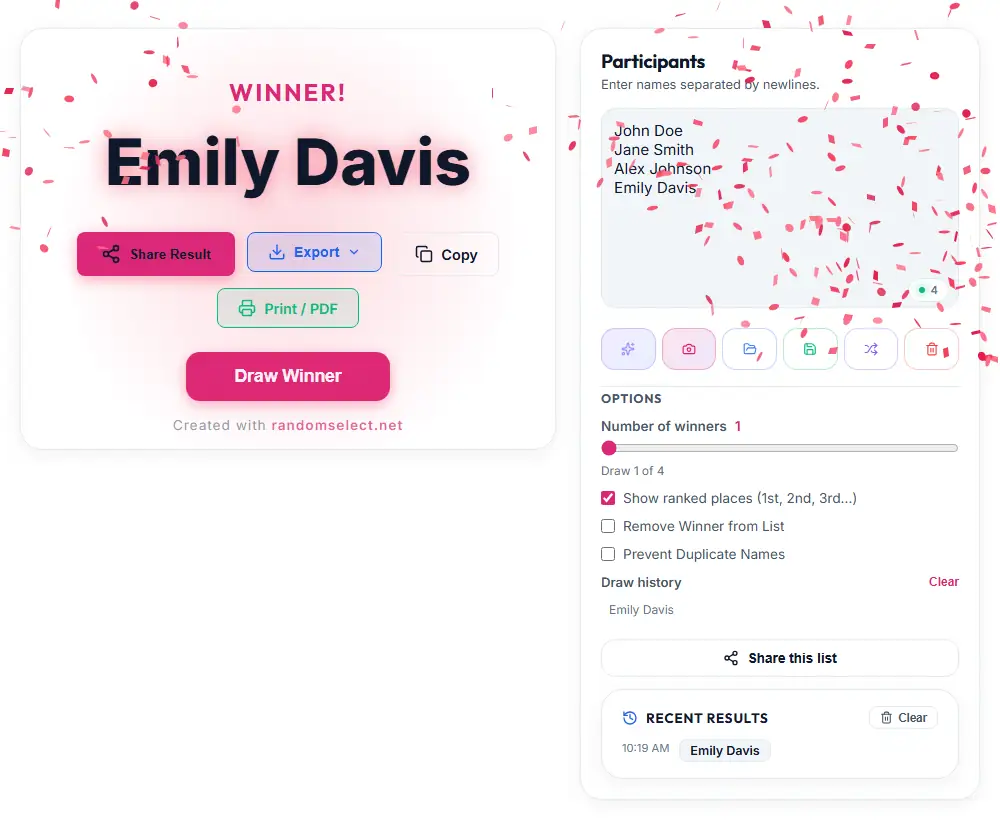
Keep the participant list visible in frame. The list is the evidence that everyone who entered was in the pool. A recording showing only the winner proves nothing about how they were chosen.
Turn on “Remove Winner” if you are drawing several prizes. It lets you draw repeatedly without the same name coming up twice, and it makes each draw visibly fair rather than only the first.
Let someone else run it if you can. If a follower or a colleague performs the draw, they cannot later be suspected of favouring anyone. This is a small change with a large effect on how the result lands.
Announcing
Publish together:
- The winning username
- The number of qualifying entries
- The recording showing the list and the result together
- A line stating that the draw used the published list
That is a complete answer to any objection. If someone still disputes it, you can point at the recording and stop engaging — which is the outcome you want, rather than a week of replies.
Contact the winner privately with a deadline you stated in the rules. And decide in advance what happens if they do not reply: a re-draw and a disqualification are both fine, as long as you published which one you would do.
The Mistakes That Cause Problems
Cleaning the list during the draw. Every adjustment after the draw starts is something a critic can point at. Do it beforehand.
Applying an unpublished rule. If someone edited their comment six times and your rules said one entry each, disqualifying on a rule you invented is the option that reliably produces a public argument. Disqualify on a rule you published, or honour the entry.
Re-running an unpopular result. This converts a fair procedure into a search for a preferred answer, and everyone watching can see it happen. If there was a genuine error, correct it publicly and re-run, saying why.
Announcing late. Credibility decays with silence. Announce on the date you published.
Forgetting the timezone. “Giveaway ends Friday” means nothing if you are on Friday afternoon and half the entries came from a timezone where it is already Saturday.
A Note on Platform Rules
Instagram’s promotion guidelines apply on top of your own rules. Worth checking the current version before you post rather than after a complaint — particularly around encouraging people to share the giveaway in ways that breach its policies, and around how a prize must be released. Requirements for prize promotions vary by country as well, so if the giveaway is open internationally or you are a business, that is worth looking into properly rather than assuming a template covers it.
Treat this as a pointer to check, not legal advice.
Before You Draw
- Rules published in the caption, unchanged since posting
- Entry closed, full comment list compiled
- Duplicate handling decided and applied
- Rule-based disqualifications applied, in advance
- Entry count verified
- Recording running, participant list in frame
- Winner-contact deadline decided
Seven steps, and the draw itself is two seconds.
Ready? Open Lucky Draw, paste the list, and start recording first.