Game nights have a recurring friction that has nothing to do with the game: the fifteen minutes before it starts, deciding who plays with whom, who goes first, and which of the four games nobody has finished gets opened.
Randomness handles all three quickly. It does not, however, make the games more fun — and pretending otherwise is how a good idea becomes an annoyance.
Where It Earns Its Place
Seeding a tournament. The strongest case, because there is a real fairness issue and it is not visible. Alphabetical seeding gives the first-listed name first choice, every time, for every game. Over a season that is a genuine advantage. Tournament Bracket handles elimination rounds including byes for an odd number of entrants.
First-player advantage. Some games give the starting player a real edge. Randomising who starts fixes it properly, and it is the same reasoning a sports league uses for first pick.
Forming balanced parties. Here is the important qualifier: a random party is not a balanced one. With one strong player in the group, a purely random split puts them in one party and makes every match against that party predictable. Seat the two or three strongest players into separate parties first, then draw the rest. Group Maker does the draw; that step is yours.
Choosing the next game. When two games are genuinely comparable and nobody wants to be the one who chose, a draw settles it in two seconds and nobody holds a grudge. Draw again next week.
Draft order. A random draft order removes first-pick advantage in the same way random seeding does.
Where It Does Not Help
Anything that rewards planning. Randomising a decision that a player would have planned well makes the game worse, not more fun. If the choice is between options of unequal quality, randomness discards preparation.
Anything mid-game. Deciding a turn outcome at random during a game destroys the game for the players who took it seriously. Reserve randomness for setup, not play.
Character generation, if anyone has an opinion. Randomising a character is a good idea right up to the point where somebody receives a class they do not want. The Wheel of Names with custom labels can build one — race, class, background — and the mitigation is to generate two options and let the player pick between them.
Anything with a real cost. Random assignment works for a party. It does not work for who drives home.
The Dice Question
Rolling is the obvious use and it is worth knowing where virtual dice are better and where they are not.
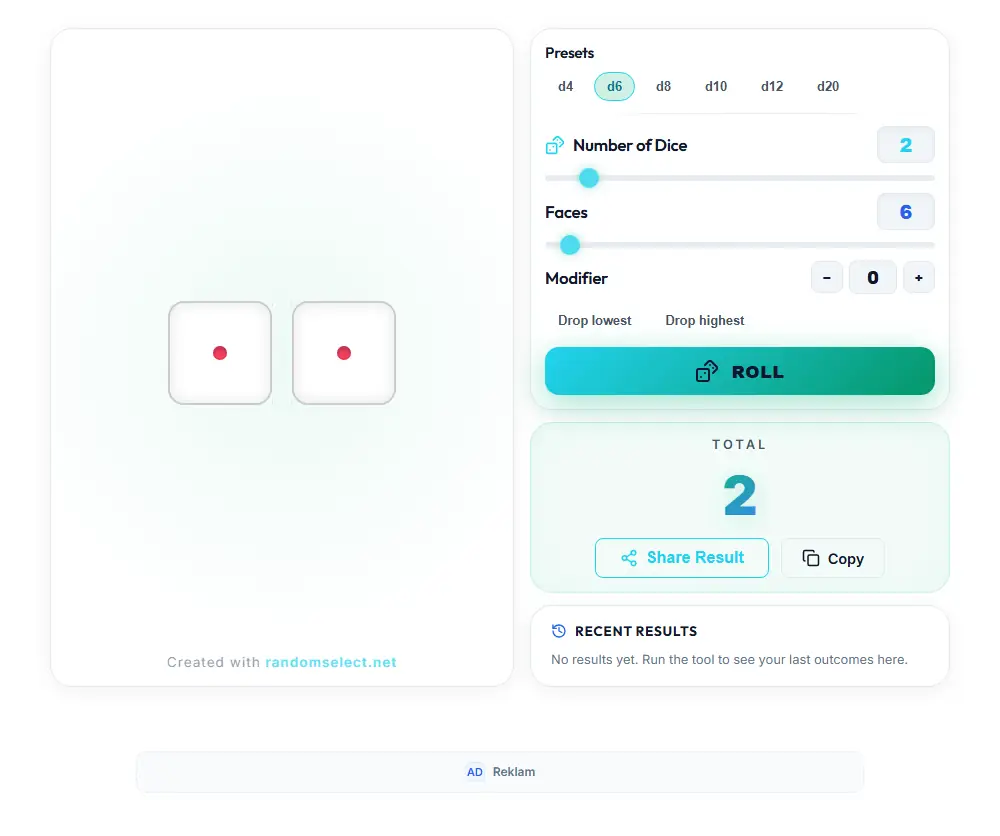
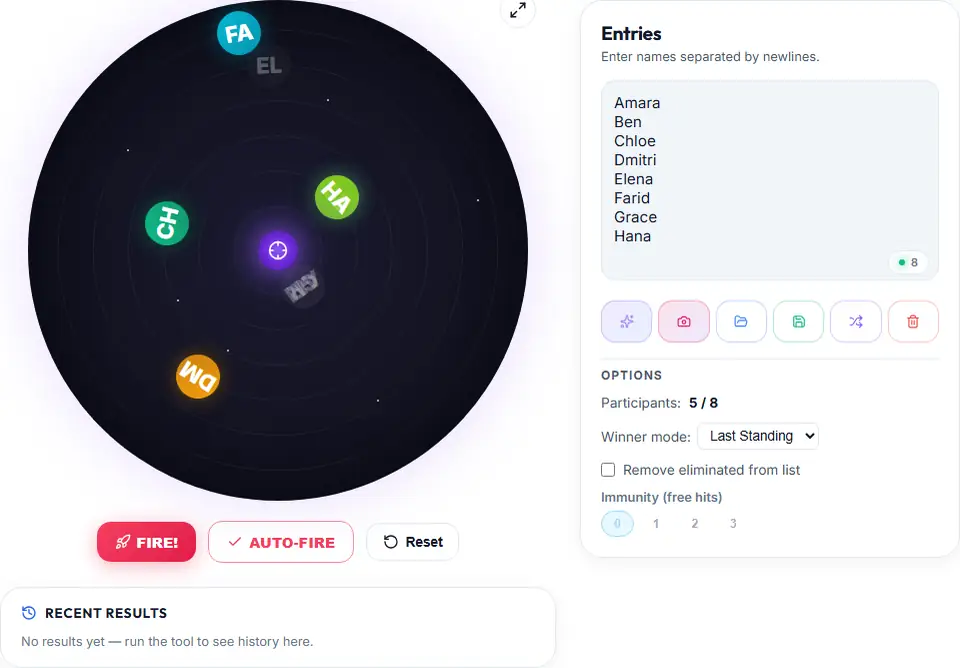
Better: a virtual die does not wear, so a die rolled ten thousand times stays uniform where a physical one does not. And when the roll appears on a shared screen for everyone at the same instant, “I swear I rolled a 20” has nowhere to go.
Not better: the sound, the tactility, and the fact that a die a player can pick up cannot be argued with. Check with the table before putting a phone down mid-game — some groups care, and asking is cheaper than the conversation afterwards.
The Dice Roller covers d4 through d20, custom faces from 2 to 100 sides, up to 12 dice at once, and modifiers from −99 to +99.
Settling Rules Arguments
Two rules disputes recur at every game night, and randomness resolves both:
“Who started the last game?” Nobody knows, and it matters. Draw it.
“We agreed on house rules.” Someone misremembered. Rather than reconstruct the argument, pick the rule that was more recently changed.
The thing to avoid is randomising a rules interpretation people actually care about — that produces someone who lost an argument rather than someone who won a game.
Screen Sharing
For remote play, sharing the screen is the entire difference between a fair draw and an asserted one.
Everyone watching the same result at the same moment removes the argument, and it takes no more effort than sharing a video call you are already on. Post the result rather than describing it — “the roll was a 7” invites “no it wasn’t” in a way that a shared screen does not.
A Note on Re-rolling
Worth stating once, because it applies to all of this: a result you do not like is a result.
A group that re-rolls until it likes the answer has not made anything fairer; it has made the process a search for a preferred outcome, and everyone can see that. Decide a cap before you start — three draws maximum — and honour it.
This applies to dice, wheels, brackets, and everything else on this page. The exception is a legitimate rules mechanic: a game that allows rerolls has an agreed maximum and that is fine.
Setup Order That Works
Before people arrive. Load the roster, save the list. Doing this live wastes the arrival window when everyone is still willing to be organised.
Draw the structural things first. Bracket seeding, then parties, then turn order. These get argued about; do them while there is time.
Save everything. Groups and brackets can be exported as CSV or XLSX, printed, or copied as text. Reconstructing a bracket from chat history after the first round is not a good use of anyone’s evening.
Decide what happens on a tie. Before you need to. A draw is a flat end and somebody will have to be told they placed second.
The Practical Summary
Randomness is for the decisions made before the game, where a fair procedure removes an argument that would otherwise consume the first fifteen minutes. It is not for the decisions made during it, where it removes the thing the players came for.
Set up with a draw. Play the game properly.